From an insider's perspective, I've seen digital credentialing platforms multiply quickly over the last few years. Universities , course creators, employers and many others increasingly rely on them. Somewhere between the rise of online learning and the explosion of micro-credentials, digital credentials quietly became the infrastructure of this very ecosystem.
Which is exactly why I say this to every client puzzled why their system isn't working in their favor:
The choice of platform matters more than ever, today.
If you are evaluating DICE ID and Hyperstack, you are likely already past the “Should we issue digital credentials?” stage. You are now asking a more serious question, something on the lines of:
At first glance, DICE ID looks like a safe choice. It comes from Wipro, runs on blockchain infrastructure, and aligns with standards from the World Wide Web Consortium.
But once credential programs move from theory to real-world usage, something else becomes more important than architecture diagrams.
After issuing credentials across learning programs and certification ecosystems for years, we noticed a consistent pattern.
Credential platforms rarely fail because of weak security or missing standards. They struggle because everyday tasks become unnecessarily complicated.
The friction appears in small places: claiming a credential, integrating with an LMS, onboarding recipients, managing identity wallets.
Individually, each step seems manageable. Together, they create the kind of operational headaches no team wants to deal with on a Monday morning.
This article examines Wipro DICE ID vs Hyperstack through that lens: what DICE ID does well, where its architecture introduces real-world friction, and why many organizations are choosing a different approach.
TLDR:
- DICE ID is a blockchain-based credential system built by Wipro, designed around decentralized identity wallets and enterprise blockchain infrastructure.
- Hyperstack is modern credential infrastructure built for simplicity and global adoption. It anchors verification on Hedera Hashgraph while keeping the distributed ledger invisible to issuers and recipients.
- In practice, most credential programs succeed or fail based on:
- how easily recipients can claim credentials
- how quickly organizations can deploy the platform
- how smoothly credentials integrate into existing systems
- On most fronts, Hyperstack is usually the more practical choice.
Conversations around digital credentials often drift toward impressive technical language: blockchain verification, decentralized identity, cryptographic proofs.
All interesting concepts.
But after issuing credentials across thousands of learners, we noticed that real credential programs succeed or struggle based on far simpler factors.
Recipient adoption
If recipients struggle to claim credentials, the entire initiative loses momentum.
Deployment speed
Credential programs rarely have months for infrastructure rollouts.
Integration simplicity
Credentials must work smoothly with LMS platforms, HR systems, and certification workflows.
Global usability
Credentials should travel easily between institutions, employers, and countries.
Once you evaluate platforms through these lenses, the differences between DICE ID and Hyperstack become much clearer.
What is DICE ID?
DICE ID is a blockchain-based credential platform launched in 2023 by Wipro through its innovation unit Lab45.
The system issues credentials using W3C Verifiable Credentials, a framework developed by the World Wide Web Consortium.
Instead of storing credentials centrally, DICE ID follows a decentralized identity model where credentials live inside recipient-controlled identity wallets.
The workflow generally looks like this:
Issuer creates credential → recipient stores it in a wallet → verifier checks authenticity through blockchain-backed proofs.
From a technical standpoint, the design is elegant. It aligns with emerging decentralized identity frameworks and gives recipients control over their credentials.
The platform also offers a freemium structure. Organizations can use DICE ID free for up to roughly 200,000 credential transactions before paid tiers apply, making it obvious why many teams explore the platform during early credential program experimentation.
Much of the ecosystem around DICE ID currently centers on India, where its working group includes dozens of organizations participating in skills credentialing initiatives.
This enterprise credibility of Wipro gives the platform legitimacy, although its adoption footprint outside South Asia remains relatively limited.
Now let's look at the smoother end of things.

What is Hyperstack?
Hyperstack approaches credential infrastructure from a different starting point.
Instead of beginning with blockchain architecture, the platform begins with the everyday realities of credential programs.
Recipients always forget passwords. Students love skipping complicated onboarding steps.
Certification teams prefer dashboards over developer documentation and HR departments want integrations measured in hours, not weeks.
Hyperstack was built for that environment.
The platform supports open standards such as Open Badges 3.0 and W3C Verifiable Credentials, while anchoring credential verification on Hedera Hashgraph.
The distributed ledger works quietly in the background while the platform behaves like a familiar SaaS product for issuers and recipients.
Recipients never need to install identity wallets or manage cryptographic keys. Credentials are delivered through secure links and can be verified instantly.
That simplicity matters in reality more than on paper.
After issuing credentials across large cohorts, we noticed that every additional step between “You earned this credential” and “You can share it” quietly reduces adoption. The more complex the claiming process becomes, the fewer recipients actually complete it.
Hyperstack was designed to remove those steps entirely.
Issuers can create and distribute credentials through a streamlined dashboard, automate large issuance workflows, and integrate credential delivery directly into their existing systems. Recipients receive a credential they can claim immediately and share across professional platforms without navigating new identity tools.
This approach also brings operational advantages. Programs can launch faster because teams are not required to deploy decentralized identity infrastructure or train recipients on wallet management. Integrations with LMS, HR platforms, and learning ecosystems can be configured quickly, allowing credential programs to scale without heavy engineering overhead.
Beyond simplicity, Hyperstack also provides the operational capabilities credential programs require as they grow. Issuers can automate credential issuance across large cohorts, manage branded certificates and badges, and embed credential delivery directly within existing learning or certification workflows.
Each credential includes a verification layer that allows employers, institutions, or third parties to confirm authenticity instantly.
Recipients can share credentials through portable links or professional networks, allowing achievements to travel easily across hiring platforms and digital portfolios.
For organizations issuing thousands of credentials across courses, certifications, or professional programs, these small operational improvements compound quickly in their favor.
What begins as a simple credentialing tool becomes infrastructure for recognition and professional mobility.
In short, Hyperstack delivers ledger-anchored verification without the operational friction typically associated with blockchain-based credential systems. Issuers get the security and interoperability of modern credential standards, while recipients experience a hassle-free process.
Ready to See How Modern Credential Infrastructure Works?
If you are evaluating credential platforms, it helps to see how issuance actually works in practice.
Schedule Hyperstack’s free demo to see how credentials can be issued, claimed, and verified without identity wallets or complex infrastructure. Our experts can give you a clear picture of how to tailor your credentialing program to work for you.
But if you're exploring multiple platforms beyond DICE ID and Hyperstack, try our guide on DICE ID alternatives for an in-depth analysis.
Where DICE ID Falls Short
DICE ID is a serious attempt to advance decentralized credential infrastructure.
But architecture choices come with trade-offs, and several of those trade-offs become visible once credential programs move beyond pilot scale. Here's what should catch your attention.
The Wallet Friction Problem:
DICE ID requires recipients to install and manage an identity wallet to store credentials. From a decentralized identity perspective, this design makes sense.
From a user adoption perspective, it introduces friction.
We noticed something consistent across credential programs in multiple ecosystems. The moment 'claiming' a credential requires additional setup steps, redemption rates begin to fall.
A typical DICE ID credential flow involves firstly installing a wallet, creating an identity profile, then managing keys, and finally importing your credentials.
For technically comfortable users, that process may be acceptable; but for many learners or professionals, it feels unnecessarily complicated. When someone finishes a course or certification, their next thought is usually simple: Where can I share this credential?
Nobody looks forward to configuring a digital identity wallet from scratch.
Blockchain-Integration Complexity:
DICE ID implementations often involve Docker containers, API integrations, blockchain configuration, and credential schema management. Organizations with blockchain expertise may manage this comfortably.
Most credential programs, however, operate inside learning teams or HR departments.
Those teams typically prefer tools that can be deployed in hours rather than infrastructure projects that require engineering resources and extended implementation cycles.
Research published in the Journal of Business Research (2024), identifies enterprise hesitation around blockchain adoption as a persistent barrier, largely due to integration complexity.
GDPR and Data Deletion Complexity:
Another structural challenge involves privacy regulation.
The General Data Protection Regulation (GDPR) grants individuals the right to request deletion of personal data.
Blockchain infrastructure, however, is designed around immutability. Once verification proofs are anchored to a ledger, removing or modifying those records becomes technically complex.
Some blockchain credential systems attempt architectural workarounds by storing only hashes or indirect references on-chain. While these approaches can reduce risk, they still introduce additional compliance considerations for organizations operating in the European Union.
For many credential issuers, this complexity raises a simple question: why adopt infrastructure that makes data deletion harder than it needs to be?
Credential platforms that rely on traditional data architectures only allow organizations to manage credential data and deletion requests through standard data lifecycle processes.
Fragmented Credential Ecosystems:
Despite widespread adoption of W3C Verifiable Credentials, the blockchain credential ecosystem remains fragmented across protocols, wallet systems, and identity frameworks.
Organizations that choose a blockchain credential platform are effectively betting that the specific protocol ecosystem they adopt will achieve long-term industry adoption.
If that very adoption remains limited, credentials may exist inside a smaller network of compatible tools. Migrating credential archives later eventually becomes operationally expensive.
Regional Ecosystem Focus:
DICE ID’s early ecosystem development is strongly centered around India.
For organizations operating within that environment, this may be advantageous.
For global credential issuers, however, questions arise around international adoption, employer recognition, and cross-border interoperability.
We know that credential infrastructure platforms built for global ecosystems typically invest heavily in international adoption and compliance coverage.
Hence, regional ecosystems sometimes struggle to expand beyond their initial geography. When platforms designed for global credential issuance typically prioritize international interoperability from the beginning, credentials can move seamlessly across employers, institutions, and countries.
In practice, most credential issuers are not trying to build decentralized identity ecosystems. They are trying to issue credentials that recipients can easily claim, share, and instantly verify. Platforms that remove unnecessary technical complexity tend to perform better in real credential programs.
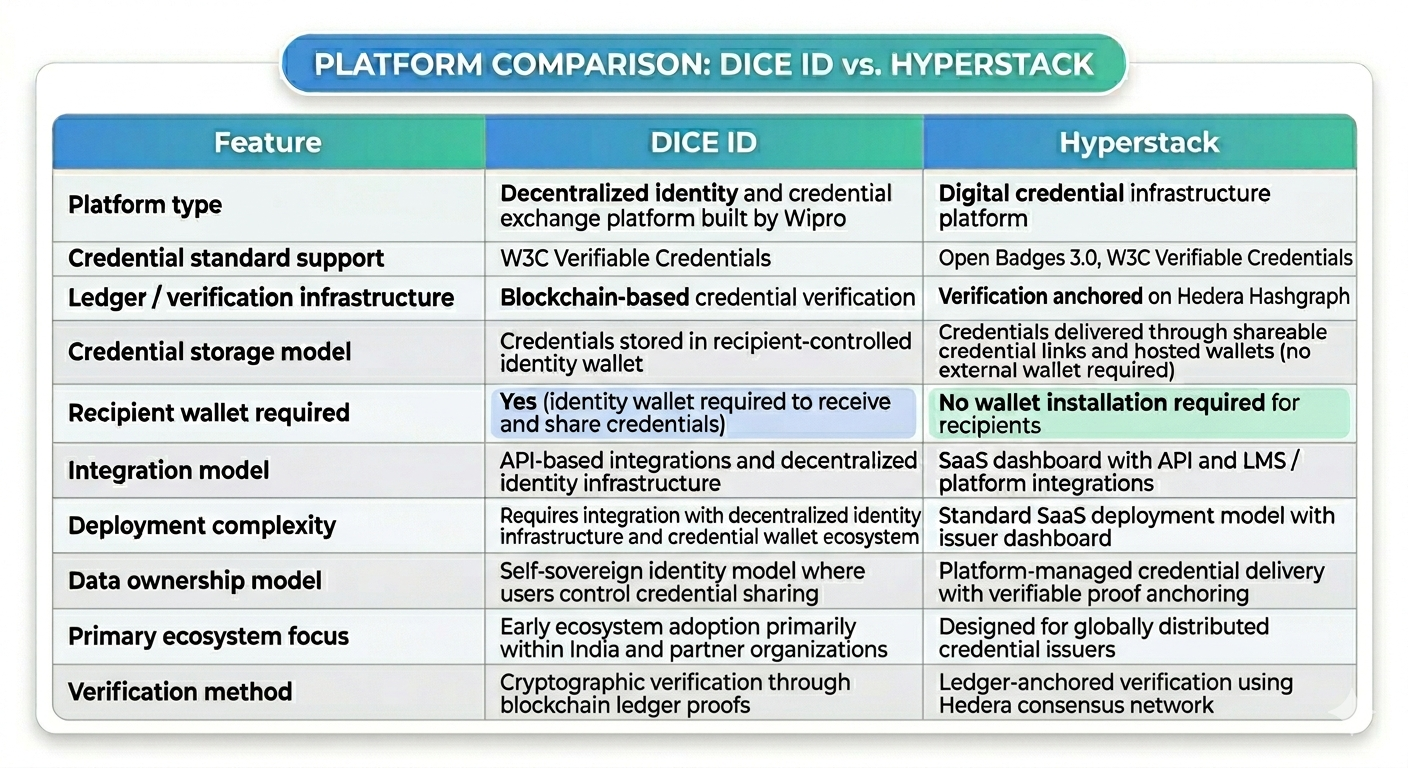
Comparison Table for a Quick Assessment:
Choosing between DICE ID & Hyperstack:
DICE ID may work if:
- Your organization already operates inside the Wipro ecosystem
- You have internal teams comfortable managing blockchain infrastructure
- Your credential recipients are technically comfortable using identity wallets
- Your credential programs operate primarily within India or partner ecosystems connected to DICE ID
Hyperstack makes more sense when:
You want credentials issued quickly without infrastructure complexity
- Your recipients include students, professionals, or learners without technical expertise
- You want higher credential redemption and sharing rates
- Your credential programs operate globally
- You prefer standards-based verification without requiring identity wallets
The effectiveness of a digital credential system is often measured by one simple metric: how many recipients actually claim and share their credentials.
As a credentialing expert, watching enterprises make difficult choices has taught me what really happens once they do. And here's some insider information: platforms that reduce friction in the claiming process are bound to see significantly higher engagement.
For many issuers, this is where Hyperstack provides a practical advantage.
Verdict
DICE ID is an ambitious attempt to bring decentralized identity principles into credential infrastructure. Backed by Wipro and built around W3C Verifiable Credentials, the platform carries genuine credibility and has gained early traction within its ecosystem.
But real-world credential programs rarely operate in theoretical environments.
Organizations issuing credentials at scale tend to prioritize reliability, usability, and integration with existing systems over experimental identity architectures.
Wallet-based credential systems can introduce friction for recipients, especially those unfamiliar with decentralized identity tools. Blockchain-based credential frameworks may also add additional integration layers compared with traditional SaaS platforms. And in regions governed by privacy frameworks such as GDPR, immutable ledger records can introduce architectural considerations when data deletion or modification is required.
For organizations actively building decentralized identity ecosystems, DICE ID may still be worth exploring.
For most credential issuers, however, the priorities are simpler. They want credentials that are easy to issue, easy to claim, and easy to verify instantly.
If the underlying technology complicates those basic tasks, the infrastructure may be solving the wrong problem.
Platforms like Hyperstack focus on those very fundamentals.
By anchoring credential verification on Hedera Hashgraph while keeping the distributed ledger infrastructure invisible to recipients, Hyperstack delivers standards-based credentials without requiring users to install external identity wallets or interact with blockchain infrastructure directly.
In practice, that balance between security and simplicity is often what determines whether a credential program actually succeeds.
For organizations evaluating credential infrastructure today, that balance of security, simplicity, and adoption is often the deciding factor.
Explore Hyperstack in Action
Curious how ledger-backed credentials can work without wallet friction or complex blockchain setup?
Start a Hyperstack demo or schedule a free trial and see how quickly your credential program can move from idea to issuance.
FAQs
1. Which is better: Wipro DICE ID or Hyperstack?
It depends on your use case. DICE ID is suited for organizations exploring decentralized identity ecosystems with wallet-based credentials. Hyperstack is typically a better fit for organizations that prioritize ease of use, faster deployment, and higher credential adoption without requiring recipients to manage identity wallets.
2. Does DICE ID require users to install a wallet?
Yes. DICE ID generally requires recipients to use an identity wallet to store and manage credentials. While this aligns with decentralized identity models, it can introduce additional steps in the credential claiming process.
3. Does Hyperstack use blockchain technology?
Hyperstack anchors credential verification on Hedera Hashgraph, a distributed ledger technology. However, the infrastructure remains in the background, and users are not required to interact with blockchain systems or install wallets.
4. Which platform is easier to implement for organizations?
For most organizations, Hyperstack is easier to implement because it follows a SaaS model with faster setup, simpler integrations, and no requirement to deploy decentralized identity infrastructure. DICE ID may require more technical planning and integration effort.
5. Is DICE ID suitable for global credential programs?
DICE ID has strong roots in India and aligns with global standards like W3C Verifiable Credentials. However, organizations operating across multiple regions may need to evaluate ecosystem adoption and integration requirements before choosing it for global programs.
6. How does Hyperstack improve credential adoption rates?
Hyperstack reduces friction in the credential claiming process by eliminating the need for identity wallets and complex onboarding. Credentials can be claimed and shared instantly, which typically leads to higher recipient engagement and usage.
7. What should organizations consider when choosing a digital credential platform?
Key factors include ease of use, recipient experience, integration with existing systems, scalability, compliance requirements, and how easily credentials can be claimed, shared, and verified. Platforms that minimize friction while maintaining strong verification standards tend to perform better in real-world credential programs.