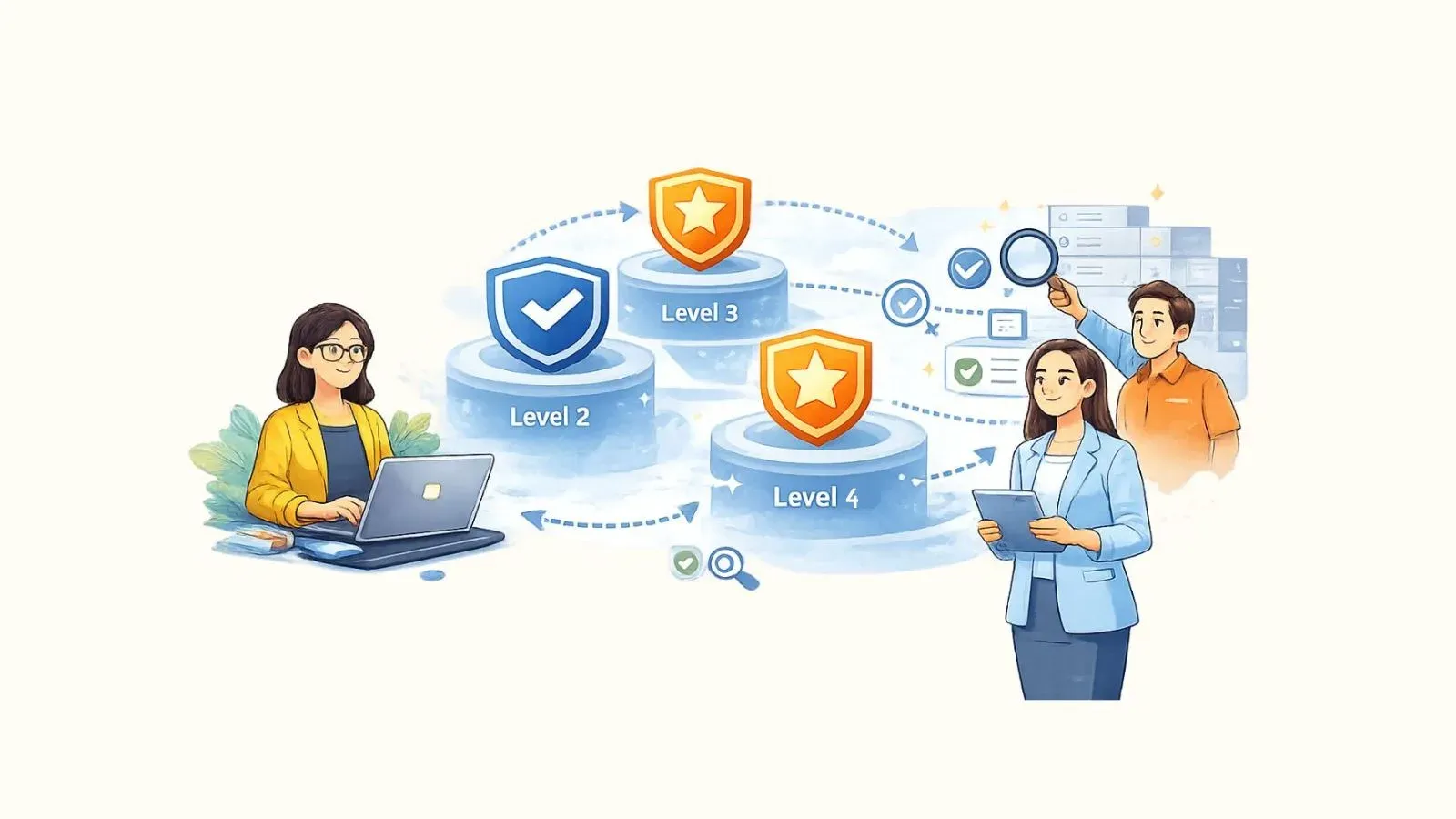
Badgr and LMS-Native Recognition Tools
Badgr is often where digital credentialing journeys begin, particularly for teams operating inside a learning management system. In this context, badges function as part of the learning experience rather than as independent credentials.
This category of tools is obviously designed to reinforce participation, completion, or progress within a course. The audience inherently understands the learning environment, and verification happens implicitly through platform context.
Note: What many teams still recognize as Badgr now lives within the Parchment credentialing ecosystem following its acquisition by Instructure. The badge experience itself remains familiar inside LMS workflows, but the name change signals a wider shift toward consolidated credentialing ecosystems across academia and enterprise.
Badgr fits naturally when:
- Credentials are primarily instructional signals
- Learners consume badges contained within an LMS
- External verification is limited or informal
For early-stage programs or LMS-bound use cases, this model is efficient and predictable. Administration is centralized, workflows are familiar, and credentialing remains tightly coupled with instruction.
As programs mature, however, credentials often begin to outgrow the LMS. Learners share them externally. Employers and partners encounter them without platform context. At that point, verification can no longer depend on knowing where the credential came from.
This is not a limitation of Badgr itself. It is a shift in how credentials are expected to function.
Issuance-First Credential Platforms (CertifyMe, Certopus, GiveMyCertificate, Sertifier)
The next category institutions often evaluate is issuance-first platforms. These tools are optimized for producing credentials efficiently and at scale.
Platforms such as CertifyMe, Certopus, GiveMyCertificate, and Sertifier are commonly shortlisted when the primary challenge is issuing large volumes of credentials quickly and reliably, rather than managing long-term credential value.

They tend to work well when:
- Large numbers of certificates or badges must be issued quickly
- Workflows need to be repeatable across cohorts or events
- Administrative overhead must remain low
Training providers, certification bodies, and event-led programs often favor this category because it removes friction from issuance. Credentials are generated reliably, delivered predictably, and managed with minimal setup.
Where institutions begin to reassess is not issuance quality, but what happens after issuance.
As credentials circulate externally and remain in use over time, new questions emerge:
- How are credentials verified by third parties?
- What happens if systems change or programs evolve?
- How is trust maintained beyond the issuing platform?
These questions reflect a change in usage, not a failure of the tools. Issuance-first platforms solve a specific problem well. They are not designed to act as long-term credential infrastructure.
Entry-Level Badge Tools and Early Credential Experiments (Virtualbadge.io)
Entry-level badge platforms such as Virtualbadge.io are often chosen at the very start of a credentialing initiative. Their appeal lies in accessibility.

Quick onboarding and minimal setup make them suitable for experimentation, pilots, or low-stakes recognition programs.
They tend to fit when:
- Credential programs are exploratory
- Badges are used for engagement or visibility
- Verification expectations are minimal
At this stage, speed and simplicity matter more than durability.
As programs grow, however, credentials begin to take on a different role. They are shared publicly, referenced externally, and expected to retain meaning outside the issuing team or tool.
This is often when evaluation criteria change. Cost remains relevant, but it is no longer the defining factor. Longevity, independent verification, and governance start to matter once credentials need to stand on their own.
The question shifts from:
“How easy is this to set up?” to,
“What happens to these credentials when we are no longer there to explain them?”
That shift signals a move away from tooling toward infrastructure.
When Credentialing Becomes Infrastructure
At the enterprise and institutional level, credentialing eventually becomes less about issuing artifacts and more about maintaining trust over time.
This is the stage where organizations begin evaluating credentialing infrastructure platforms. The focus expands to include:
- Platform-independent verification
- Long-term accessibility
- Governance across systems and regions
- Security, compliance, and audit readiness
Rather than replacing existing tools outright, institutions often layer infrastructure platforms alongside them. LMS tools continue to support learning workflows. Issuance platforms handle operational scale. Infrastructure platforms ensure credentials remain verifiable and trustworthy beyond any single system.
This layered model reflects how credentialing actually evolves in practice.
Where Hyperstack Enters the Evaluation

Hyperstack is usually evaluated at the point where credentials stop behaving like course byproducts and start acting like records that need to hold up over time.
At this stage, credentials aren't confined to a single learning environment. They are shared externally, reviewed by employers or partners, and expected to remain trustworthy long after a course ends. This shift naturally changes how organizations assess credentialing platforms.
Hyperstack tends to come into consideration when:
- Credentials must remain verifiable without relying on the issuing platform
- Programs operate across institutions, partners, or geographic regions
- Security, privacy, and audit readiness are part of procurement discussions
- Credentials need to retain value beyond the lifecycle of a course or system
The evaluation moves beyond issuance alone. Verification, governance, and long-term accessibility start to matter just as much as delivery.
How Hyperstack Works
In practice, Hyperstack is often introduced as a foundational layer within an organization’s credentialing ecosystem. Rather than forcing immediate, system-wide change, it complements existing tools already in use.
Badge tools and LMS integrations may continue supporting instructional or internal recognition use cases. Hyperstack is typically added where credentials need to function independently and carry weight outside the learning environment.
This includes:
- Externally facing credentials
- Employer-recognized or high-stakes certifications
- Credentials that must remain valid and verifiable across platforms
This layered approach allows organizations to strengthen trust and portability without disrupting established workflows. It reflects how credentialing evolves in real programs, not how it looks in a clean-room diagram.
Choosing Credentialing Platforms Based on Program Maturity
Credentialing platforms tend to work best when they align with the stage and scope of the program they support.
- LMS badge tools serve early-stage or tightly scoped learning programs
- Issuance-focused platforms prioritize speed, automation, and high-volume delivery
- Verifiable credential platforms support trust, portability, and long-term governance
Hyperstack sits in this last category, where credentials function as part of an organization’s trust infrastructure rather than as instructional signals alone.
If you are evaluating options today, the most useful question is not which platform offers the longest feature list. It is which platform supports where your credentialing program is headed next, especially as expectations around verification, compliance, and global portability continue to rise.
And if you are already sensing friction between how credentials are issued and how they are expected to perform in the real world, that signal is usually worth paying attention to.
If You Are Still Comparing Categories
If your evaluation is still focused on understanding the difference between LMS-issued badges and digital credentialing platforms more broadly, starting with a category-level comparison can help clarify where each model fits.
This article from our blog series breaks down those distinctions in detail:
LMS-Issued Badges vs Digital Credentialing Platforms
Closing perspective
Badgr is often where credentialing initiatives begin. As programs scale, credentialing requirements evolve toward verification, portability, and longevity.
The transition is less about replacing tools and more about recognizing when credentials stop being learning artifacts and start becoming part of an organization’s trust layer.
Understand what infrastructure-grade credentialing looks like for your programs.
Schedule a conversation with our experts at your convenience, explore your best fit, next steps and understand how a layered approach can support long-term growth for your organization.
Frequently asked questions
LMS-issued badges are typically tied to a specific learning platform and are designed to recognize course completion or participation. Verifiable credentials, on the other hand, are built to function independently of the issuing system, allowing third parties to verify authenticity without accessing the original platform.
Organizations usually begin exploring alternatives when credentials are shared externally, reviewed by employers or partners, or expected to remain valid long after a course ends. At that point, verification, portability, and long-term access become more important than issuance alone.
Yes. Badge platforms often continue to serve instructional or internal recognition use cases. Many organizations use them alongside verifiable credentialing platforms, rather than replacing them entirely.
A verifiable credential can be independently authenticated by a third party. This typically involves cryptographic verification, stable credential URLs, and clear issuer attribution, ensuring trust without relying on manual confirmation.
As programs expand, teams often adopt a layered approach. Learning platforms manage instruction and engagement, while credentialing infrastructure handles verification, governance, and long-term access across systems and regions.
Credentials often contain identity and achievement data. As they are shared publicly or reviewed externally, organizations must ensure data protection, audit readiness, and consistent security controls, especially in regulated or enterprise environments.
The decision depends on program maturity and long-term goals. Early-stage programs may prioritize ease of issuance, while mature programs often prioritize verification, portability, and governance. Evaluating where your credentialing strategy is headed next usually leads to better platform choices than comparing features alone.
Tags