The future of learning is seldom built on long semesters or monolithic training blocks. It is almost always built on small moments that carry big meaning. Short bursts of learning that stack, verify, and compound into trusted signals. This is the logic behind micro learning, and this is why it now stands at the center of modern credential ecosystems.
Micro learning is not a trend. It is a structural response to how people learn today, how industries evolve, and how employers evaluate skill readiness. As institutions and training providers shift from content-heavy experiences to outcome-centered design, micro learning becomes the mechanism that ties daily learning habits to large, meaningful credentials.
This article explores how micro learning creates macro credentials. It looks at why this model works, how institutions can adopt it, and what happens when learners move through a world where short learning cycles generate long-term verifiable reputation.
The Rise of Micro Learning: A Structural Shift, Not a Shortcut
Micro learning is often misunderstood. Many assume it is about making courses shorter or reducing academic rigor. In reality, micro learning allows complex knowledge to be delivered in smaller, targeted, more digestible units without compromising integrity.
The shift toward micro learning is driven by four forces:
1. Cognitive research supporting shorter learning intervals
Humans retain more when information is delivered in short, meaningful bursts.
2. Workforce demand for continuous upskilling
Skills evolve faster than curriculum cycles. Micro learning allows learners to stay current without waiting for full program updates.
3. Technology that rewards modularity
Digital platforms, learning apps, and skill engines interpret short structured learning activities more efficiently.
4. Hiring ecosystems shifting to verifiable skills
When employers want proof, short cycle learning aligned with clear outcomes becomes more valuable than lengthy courses without precision.
Micro learning does not make learning smaller. It makes learning more accessible, measurable, and trackable.
Why Micro Learning Produces Stronger Credentials
The phrase “macro credential” tends to refer to durable, trusted, widely recognized achievements such as professional certificates, university micro degrees, and workforce-aligned qualifications. What makes these credentials powerful is not their size but their clarity.
Institutions often overlook this: a credential becomes powerful because its component skills are clear, verifiable, and structured.
Micro learning strengthens macro credentials because:
- each unit contains a focused outcome
- each outcome connects naturally to a skill
- each skill can be verified quickly
- each verification strengthens the credential’s reputation
Large credentials built on weak internal structure struggle to signal value. Credentials built on micro learning gain precision, granularity, and trust.
If your institution is exploring micro learning but unsure how to structure outcomes or align them with verifiable credential frameworks, Hyperstack can help you design a model that scales with minimal disruption and maximum clarity.
Schedule your free demo today!
How Micro Learning Connects to Verifiable Credentialing
A macro credential is essentially a bundle of micro-verifications. Each micro learning unit produces:
- a measurable outcome
- a small achievement artifact
- a verifiable piece of evidence
- a clear skill signal
When these micro units are stacked, they form:
- professional certificates
- specializations
- academic micro degrees
- workplace qualifications
- industry-aligned digital credentials
The relationship between micro learning and credentialing is similar to the relationship between atoms and molecules. Micro units provide the granularity. Macro credentials provide the structure.
Together, they create value that is both meaningful and measurable.
Micro Learning in University Ecosystems
Universities often assume micro learning is better suited for corporate training. In reality, universities stand to gain the most. Micro learning allows academic institutions to:
- segment long courses into verifiable components
- align course outcomes with employer skill frameworks
- upgrade continuing education units
- create stackable pathways that attract working professionals
- support learner re-entry and re-engagement
- modernize transcripts with skill-level visibility
A university that integrates micro learning into its curriculum immediately gains a competitive edge. It becomes more agile, relevant, and aligned with the future of academic verification.
Micro Learning in Corporate and Workforce Training
Training providers and enterprise L&D teams rely heavily on micro learning because it satisfies three business priorities:
- Speed
Training can adapt quickly to shifting workforce needs.
- Scalability
Small learning units roll out across the entire organization with ease.
- Measurement
Every interaction produces a measurable datapoint that validates training ROI.
When micro learning is tied to digital credentials, employers gain:
- audit-ready, instantaneous verification
- real-time skill dashboards
- transparent assessment practices
- better alignment with hiring and promotion decisions
In short: micro learning becomes a productivity engine.
From Micro Moments to Macro Outcomes: The Learning Stack Model
The most effective way to understand micro learning is through a stack model.
Micro Learning Events
Short lessons, simulations, exercises, demonstrations.
Micro Assessments
Quick checks. Short tasks. Performance proof.
Micro Evidence
Artifacts such as uploaded work samples, screenshots, short recordings, or automated performance logs.
Micro Credentials
Badges representing individual skills.
Macro Credentials
Larger certificates built from stacks of micro credentials.
Extended Pathways
Professional programs, advanced certificates, or micro degrees.
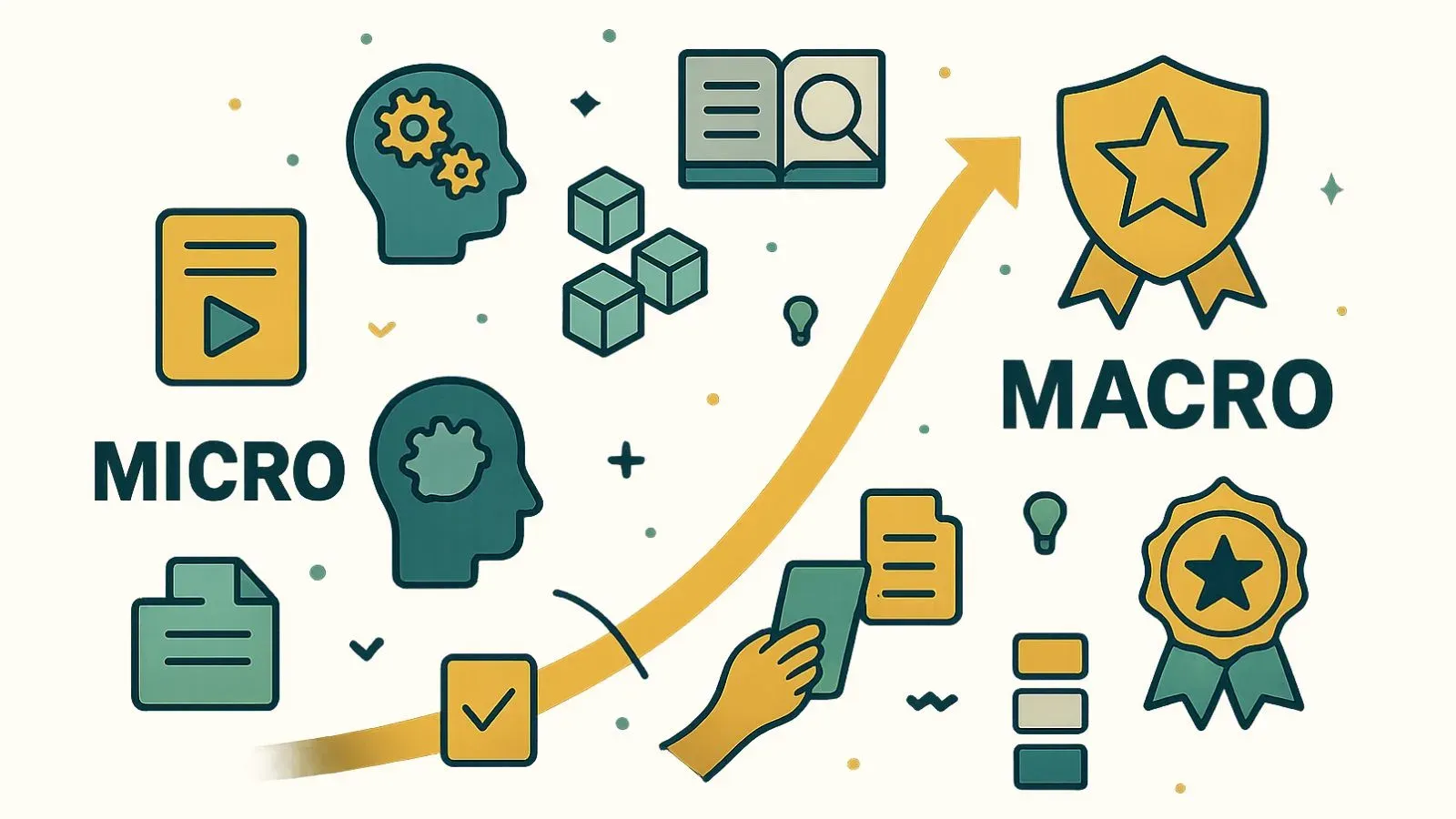
This model aligns with how learners actually consume information and how employers actually evaluate talent.
The Mindshare Loop: Why Micro Credentials Gain Influence Faster
Micro learning enters the reputation ecosystem through a powerful dynamic known as the mindshare loop.
A learner completes a micro unit.
They earn a micro credential.
They share it publicly.
Employers recognize it.
The institution issues more structured micro units.
Reputation compounds.
This loop accelerates credential recognition. It intuitively,
- travels faster
- reaches more networks
- builds trust through frequency
- increases institutional visibility
- strengthens macro credential credibility
Here's an interesting read if you want to dive into the topic: The Mindshare Loop from our blog series.
When micro credentials enter mindshare early, macro credentials achieve recognition significantly faster.
Why Micro Learning Improves Employment Outcomes
Employers have reached a saturation point. They do not want vague qualifications. They want clarity.
Micro learning connects to employment outcomes because it generates:
- precise skill signals
- clear performance evidence
- faster screening
- fairer interpretation of talent
- better alignment with role requirements
A macro credential built from micro evidence becomes far more readable than a traditional certificate.
Why Micro Learning Creates Better Learner Engagement
Most learners struggle to stay motivated inside long-form courses. Micro learning changes the engagement mechanism by:
- offering quicker progress milestones
- reducing cognitive overload
- supporting re-entry after breaks
- giving learners visible proof of advancement
- increasing confidence and autonomy
Learners stay more consistent when success happens more often.
How Institutions Convert Existing Programs Into Micro Learning Models
Most universities and training providers already have the ingredients. They simply need a structural framework.
Step 1: Break long modules into focused outcomes
Align each outcome with a skill, not a topic.
Step 2: Convert assessments into micro-evidence points
Short tasks, demonstrations, or rapid checks.
Step 3: Assign a micro credential to each skill
Badges or verifiable tokens representing the smallest meaningful achievement.
Step 4: Build macro credentials by clustering micro units
Map micro units to specializations or certificate paths.
Step 5: Enable verification and issuance
Use a platform that supports skill tagging, QR validation, and employer-readable metadata.
Step 6: Publish pathways and promote visibility
Show learners where each micro unit leads.
This process modernizes curriculum without rewriting it.
Macro Credentials: The End Product of Structured Micro Learning
When done correctly, micro learning produces macro credentials that:
- stand independently in hiring ecosystems
- communicate capability with clarity
- verify quickly
- align with employer skill frameworks
- maintain long-term relevance
- improve cross-border recognition
- support continuous learning
Unlike micro credentials, which validate a single skill (or a very narrow capability), macro credentials represent bundles of skills organized toward a larger purpose.
Examples:
• Professional Certificate in Data Analytics
• Postgraduate Diploma in Management
• Micro-Degree in UX Design
• Advanced Certificate in Cybersecurity
• Workforce Qualification in Project Leadership
Macro credentials are not larger. They are clearer. And clarity is what the modern workforce values most.
Closing Perspective
Micro learning is the engine.
Macro credentials are the outcome.
Verification is the spine that connects them.
The institutions and training providers that embrace this model position themselves at the center of the modern learning economy. They deliver faster outcomes, stronger skill signals, and better employability. They create credentials that generate trust on their own.
Micro learning is not the reduction of learning.
It is the refinement of learning.
And the credentials it powers are becoming the most trusted signals in the global talent ecosystem.
If you want to build a micro learning framework that produces employer-recognized macro credentials, Hyperstack can help you design everything from outcome mapping to verification layers.
The goal is not more content. The goal is more clarity, structure, and measurable value.
Frequently asked questions
Micro learning is an approach that delivers knowledge in short, focused learning units. Each unit targets a single outcome, making it easier for learners to absorb information and demonstrate skills without cognitive overload.
Micro learning helps institutions verify skills at a granular level. When these micro achievements are stacked and validated, they form larger, trusted macro credentials that are more readable and useful in hiring ecosystems.
No. Micro credentials represent individual skills or small achievements. Macro credentials bundle multiple micro skills, creating professional certificates, specializations, or micro degrees that reflect broader capability.
Yes. Most institutions already teach discrete skills within long modules. Converting them into micro learning units is primarily a structural and assessment redesign, not a content overhaul.
Learners gain quicker wins, better engagement, portable proof of progress, and clearer visibility to employers. It helps them build confidence and maintain momentum through longer programs.
Micro learning produces skill-level evidence. Employers gain clarity on what a candidate can do, not just what course they attended. This improves screening accuracy and reduces hiring bias.
Institutions need a credentialing platform that supports skill tagging, QR or link verification, structured metadata, and issuer identity protection. This ensures each credential can be validated independently and interpreted correctly by hiring systems.
Tags