Firefighter Training certificate templates and badges
3 free designs. A set is one design as a badge, a landscape or a portrait certificate, or all three.
Free for up to 20 recipients a year
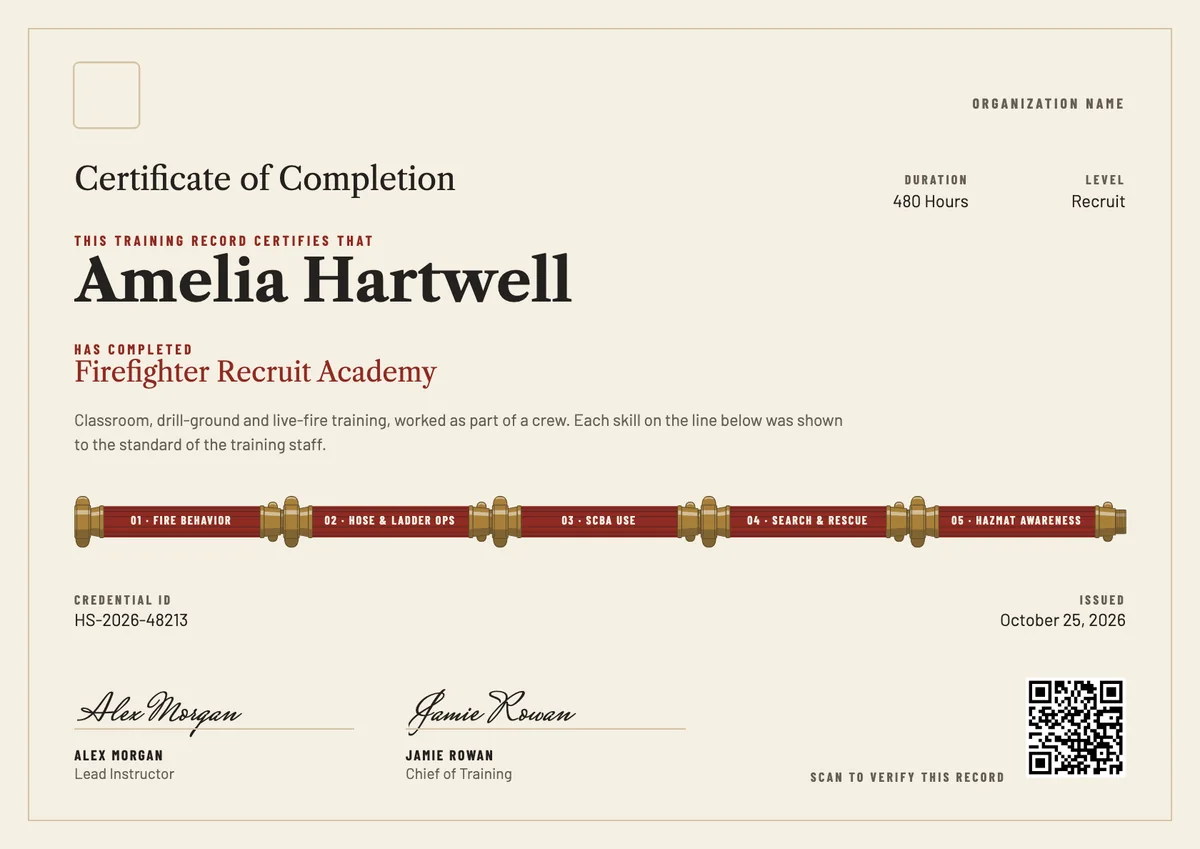
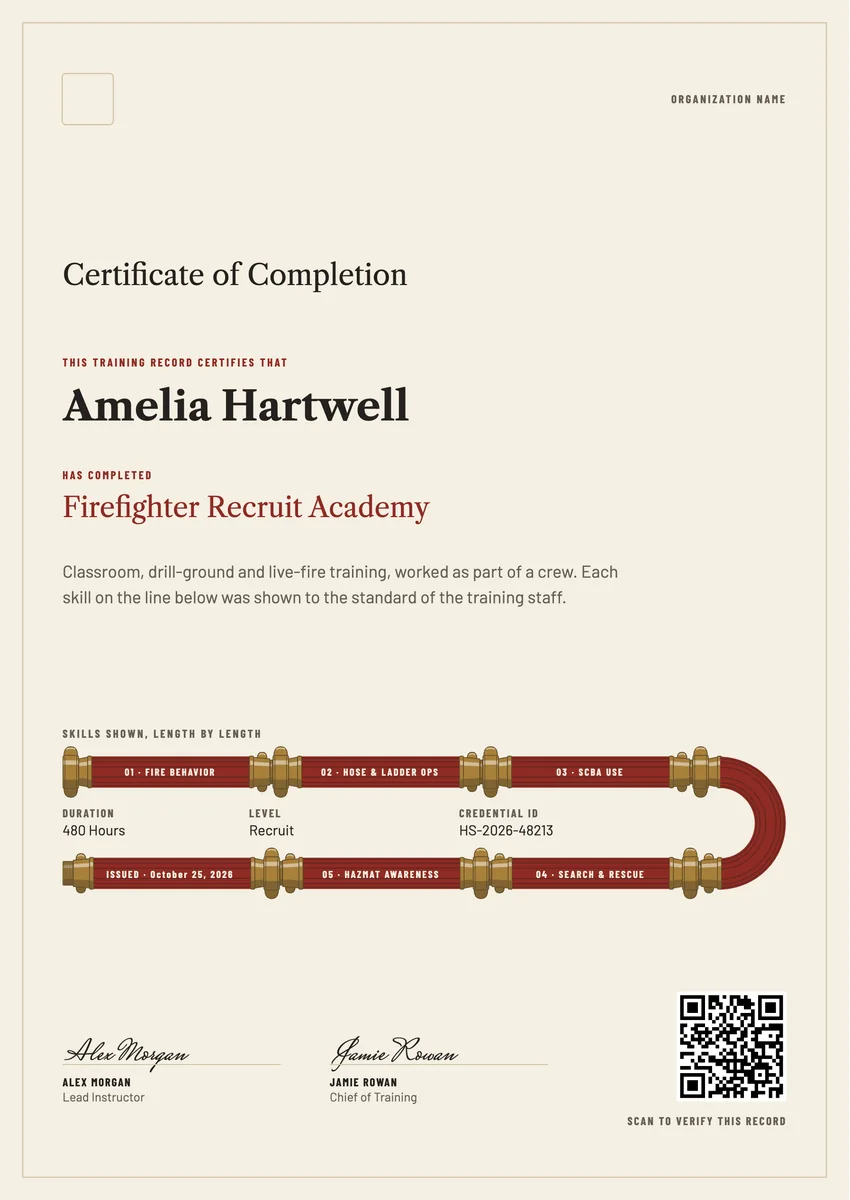
A firefighter certificate template gives a fire academy, a training centre or a volunteer brigade a clear record that a recruit has finished their training. It is handed out at the end of a recruit academy or a basic course for new volunteers, often at a graduation evening with family in the room, and it goes into the firefighter's training file.
A good firefighter training certificate names the recruit, the course and the body that ran it. It says in a sentence what the recruit has shown and lists the core skills: fire behavior, hose and ladder drills, breathing apparatus, search and rescue and hazmat awareness. Add the hours, the issue date and the signature of the training officer. It records the training; it does not replace a certification awarded after separate exams.
The designs come as certificates in A4 and US Letter and as digital badges that a new firefighter can share.
Wording
What to write on a firefighter training certificate
Use these lines as they are, or as a start for your own. Every template comes with wording you can change in the studio.
Wording for a fire academy certificate
- “Has completed the recruit firefighter academy, including classroom study, drill-ground training and supervised live-fire exercises.”
- “For completing 480 hours of recruit training and showing each core skill to the standard of the training staff.”
- “Has completed the basic firefighter course of this brigade and is ready to ride as a probationary member of a crew.”
Wording for a firefighter skills or drill certificate
- “Has completed hose and ladder drills, including advancing a charged line and raising a ladder as part of a crew.”
- “For completing breathing apparatus training, including donning, the air check and a search in limited visibility.”
Wording for a firefighter of the year certificate
- “Firefighter of the Year, for steady work on every call, help given to new members and time given to training.”
- “In recognition of service to the crew and to the community this year.”
Short lines for the badge or the email
- “Academy graduate. Ready for the crew.”
- “Every length laid, every skill shown.”
Why send it with Hyperstack
More than a PDF
Customize the template free. When it is ready, send it to everyone at once.
One design, every name
Upload a spreadsheet and Hyperstack makes a certificate of completion for each person on it, in one go.
Sent by email
Each recipient gets their own email and link. You see who opened it, downloaded it and shared it.
Anyone can verify it
The QR code opens a page that proves the certificate is real. Recipients add it to LinkedIn in one click.
FAQ
Questions, answered
Most academies mix classroom study with drill-ground work. Recruits learn how fire grows and spreads, how to wear and work in breathing apparatus, how to lay, connect and advance hose, how to raise and climb ladders, how to search a building and bring a casualty out, and how to recognise a hazardous materials scene. Many courses also include first aid or medical training and end with live-fire exercises under instructors.
The core skills are the same, but the timing is different. A career recruit usually trains full time for several weeks or months. Volunteer brigades often teach the same material in modules on evenings and weekends, so the basic course takes longer to finish. Many volunteers then join a crew as probationary members and keep adding skills at regular drill nights.
No. The academy or brigade certificate records that the recruit finished the course and showed the skills to the training staff. In many places a formal certification is a separate step, awarded by the body that sets the exams for that state or country. Name the course and the training body on the certificate, and do not call it a certification unless that body has awarded one.
Fire hose is made in standard lengths with a coupling at each end, so a line is built by joining one length to the next. Counting lengths tells the crew how far the line reaches, how much hose to pull from the appliance and where the joints will fall. Common lengths are 50 or 100 feet in North America and about 20 to 25 metres in many other countries.
Drill night is the regular training session, often once a week, where volunteers keep their skills sharp between calls. A typical night covers one or two practical drills, such as a hose lay from the appliance, a ladder raise, a breathing apparatus search or a casualty carry, followed by checks of the equipment. New members use these nights to finish the skills of their basic course, and the training officer records what each person has done.
Live-fire training puts recruits inside a real but controlled fire, usually in a purpose-built burn building or training tower, with instructors and a safety officer watching every crew. It comes near the end of the course, after the recruits are confident with breathing apparatus, hose handling and search. They practise reading smoke and heat, moving a hose line into the building and working as a crew under real conditions.
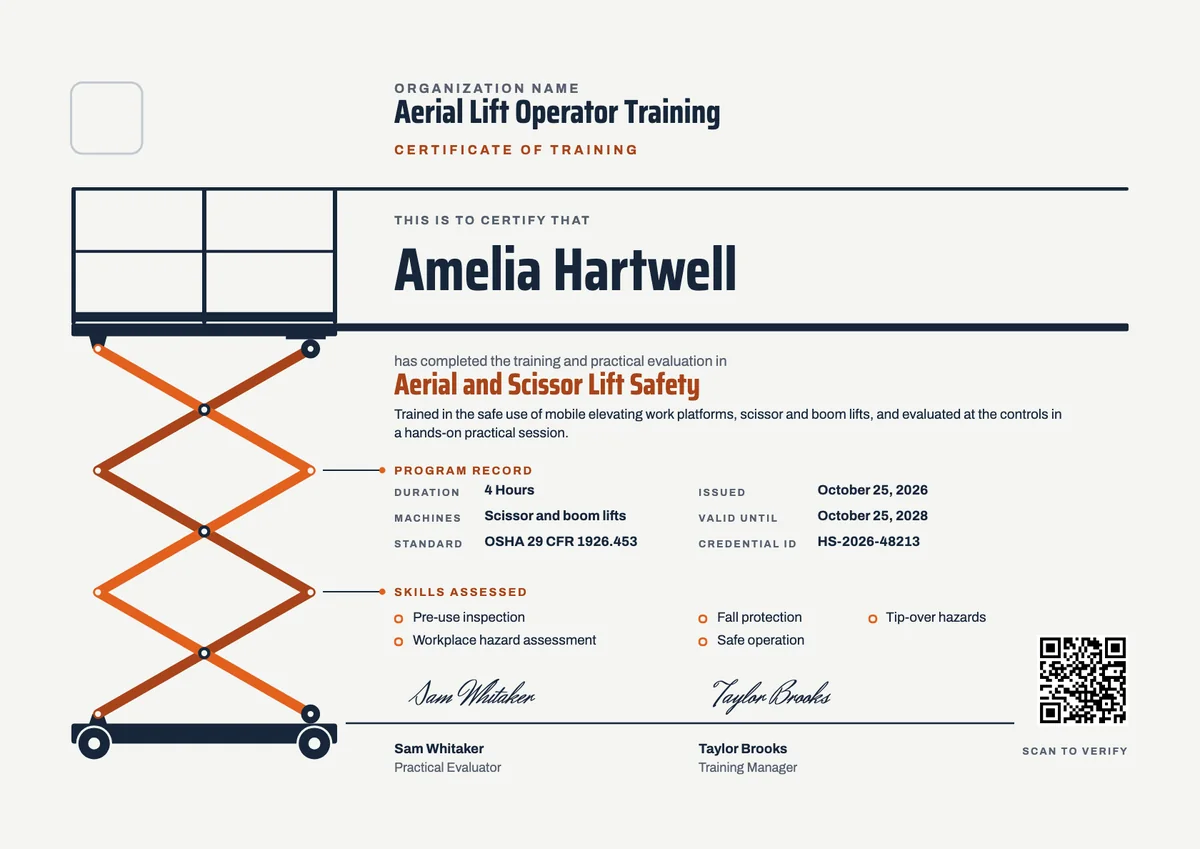
Your next cohort deserves better than a PDF
Set up in minutes, send your first credentials today, and only pay once you grow past 20 recipients a year.
Or open a live sample credential