
Online learning has moved from an alternative to an expectation.
Universities, professional training providers, and independent educators are now faced with learners who expect flexibility without sacrificing credibility at every step. Courses are no longer evaluated only by the quality of content, but by how learning is experienced, applied, and recognized.
As more learning moves online, learners look for signals that extend beyond watching and completing. Interactive sessions, practical assignments, and certificates that validate learning outcomes help turn participation into recognized progress.
We noticed this shift clearly while working with course creators at different stages. As courses scaled and learner volumes increased, the same question kept resurfacing:
How does learning remain visible once the course ends?
Course certificates answer that question quietly, but effectively.
TL;DR
- Course certificates help learners show what they’ve actually completed.
- Learners look for certificates they can share and verify easily.
- Clear certification criteria give learners a reason to finish courses.
- Manual certificate creation doesn’t scale for growing programs.
- Digital credential systems make long-term access and reissues easier.
- Thoughtful certificates add credibility to both learners and courses.
What a Course Certificate Actually Represents
A course certificate is often treated as a formality. In practice, it plays a more foundational role.
First, it confirms completion. Learners want evidence that their time and effort resulted in something tangible.
Second, it validates learning outcomes. Even when certificates are not formally accredited, they signal that learners met defined criteria within a structured program.

Third, it enables recognition beyond the course platform. Certificates make learning portable. They can be shared, verified, revisited, and referenced long after the course concludes.
We saw this repeatedly. Learners didn’t just download certificates. They shared them, linked them, and used them as proof in professional conversations. The certificate became the bridge between learning and real-world value.
Why Certificates Benefit Course Creators as Much as Learners
Certificates are usually discussed from the learner’s perspective. Their impact on course creators is just as meaningful.
Stronger perceived value
Courses that offer certificates are consistently viewed as more complete. When learners compare similar offerings, certification often becomes the deciding factor.
Higher completion rates
We saw that courses with clearly defined certification criteria experienced higher completion rates. Learners were more likely to follow through when effort and outcomes were formally recognized. This pattern mirrors what we explored earlier when examining how digital credentials influence course completion rates.
Organic course visibility
When learners share certificates publicly, they extend the reach of the course naturally. Over time, certificates become a quiet distribution channel rather than a static document.
Clearer course structure
Certificates force clarity. Defining what qualifies for completion improves curriculum design, assessment logic, and communication.
If you are planning to issue certificates for your course, it helps to think beyond design early on. Understanding how certification platforms like Hyperstack work before scaling prevents manual workflows that tend to break as learner numbers grow.
Schedule a free call to have a chat with our experts, at your convenience.
Common Requirements Learners Expect from Course Certificates
Before choosing tools or templates, it’s important to understand what learners consider standard.
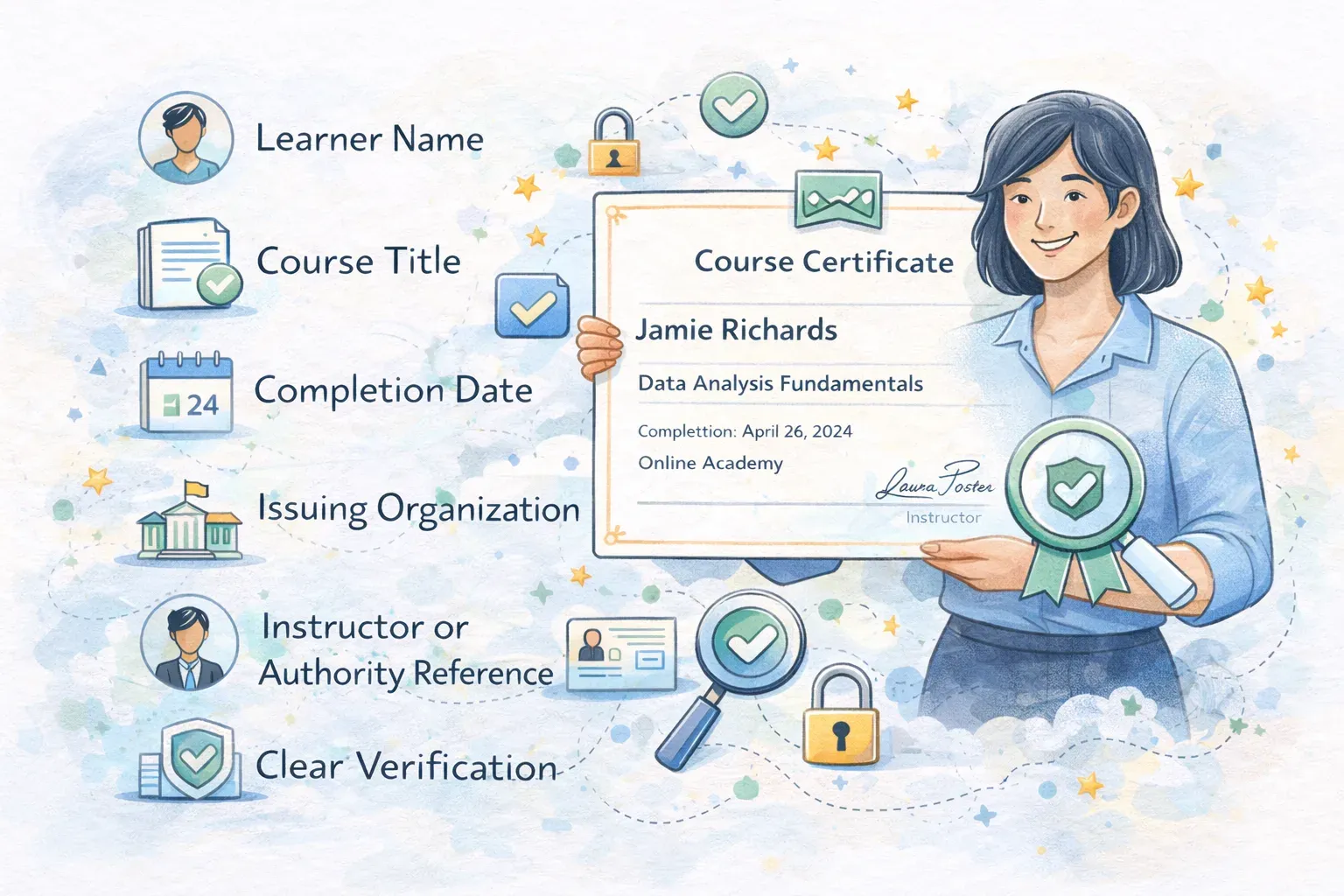
Most learners expect certificates to include:
- Learner name
- Course title
- Completion date
- Issuing organization
- Instructor or authority reference
- A clear way to verify authenticity
We noticed that verification has shifted from a “nice-to-have” to an expectation, especially for professional or career-oriented courses. This expectation is closely tied to trust, a theme we explore in more depth when discussing what makes a badge verifiable.
Tools to Create Certificates for Online Courses
There is no single “best” tool. The right choice depends on how certificates fit into your learning workflow.
What matters most is not how a certificate looks, but how it behaves over time.
Dedicated digital credential platforms
These systems are designed specifically for issuing, managing, and verifying certificates at scale.
A typical workflow looks like this:
- Define completion criteria within the course or LMS
- Trigger certificate issuance automatically or in bulk
- Generate certificates using dynamic learner data
- Deliver certificates digitally
- Enable verification through links or credential IDs
This approach is best suited for professional training programs, universities, and institutions where certificates need to be trusted, shareable, and recoverable. We saw many organizations move to this model after running into limitations with manual systems, a transition explored further in scaling fast with digital credentials for high-volume issuance.
Just as importantly, this approach reduces long-term support issues like lost certificates, name corrections, and verification requests. At Hyperstack we consider security, consistency, accessibility and simplicity as the key components of our well designed credentialing system.
Design-first tools
Design platforms are often used to create visually appealing certificates.
The workflow is simple:
- Select or design a template
- Manually personalize certificates
- Export files
- Send certificates individually
This works well for very small groups, but it scales poorly. There is no built-in verification, lifecycle management, or recovery. Over time, these tools function more as design layers than credential systems.
Document-based or spreadsheet-linked methods
Some educators use document editors combined with spreadsheets to automate name insertion.
While this reduces repetition, it introduces structural limitations:
- No centralized certificate registry
- No verification layer
- No recovery if certificates are lost
- No audit trail
This approach works only when certificates are informal and low-stakes. The long-term risks of these setups are examined in more detail in digital credential platforms vs in-house systems.
How to Choose the Right Certificate Tool for Your Course
Choosing a certificate tool is less about aesthetics and more about operational fit.
A common mistake we saw was selecting tools based solely on design. Design matters, but credibility, scale, and lifecycle management matter far more as courses grow.
Most course creators fall into one of three stages.
Early-stage or low-volume courses
If you run workshops, pilot programs, or one-off cohorts, simplicity matters most. Basic creation, manual personalization, and simple distribution may be sufficient. However, decisions made here affect future scalability. Certificates created without structure are harder to migrate later.
Growing or recurring courses
Once courses run continuously or across multiple cohorts, manual workflows begin to fail. At this stage, creators should prioritize bulk issuance, dynamic fields, centralized management, and the ability to reissue or update certificates.
This is where operational friction becomes visible and where dedicated credential systems start to make sense. For a deeper breakdown of these trade-offs, our guide on how to choose the right certificate tool for your course walks through decision-making based on scale, audience, and compliance needs.
Choosing the Right Certificate Template
Template choice should reinforce the course, not overshadow it.
Modern templates
Well suited for technology-driven or forward-looking topics. Clean layouts signal relevance and clarity.
Classic templates
Appropriate for academic or formal training programs where authority and tradition matter.
Minimal templates
Highly adaptable across industries. Minimal designs integrate well with branding and age better over time.
We saw that learners consistently responded more to clarity than ornamentation. Readability and structure mattered more than decorative detail.
Best Practices for Issuing Course Certificates
Issuing certificates responsibly protects both learners and course credibility.
Tie certificates to clear criteria
Certificates should reflect outcomes, not just attendance. Completion rules should be defined and communicated upfront.
Standardize certificate structure
Consistent naming, formatting, and metadata improve recognition and trust, especially when certificates are shared publicly.
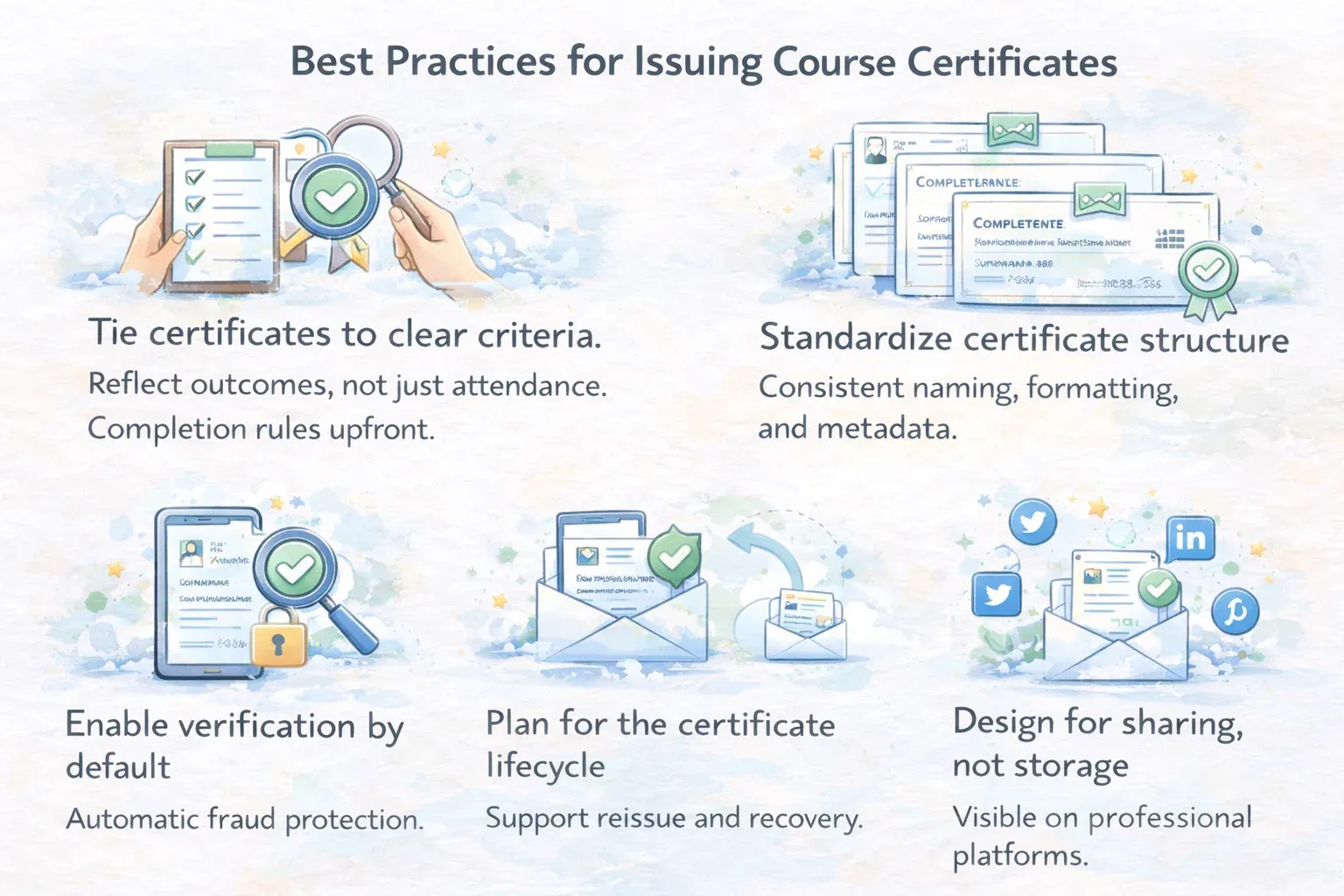
Enable verification by default
Verification reduces manual checks and builds confidence. It also protects against misuse, a growing concern discussed in credential fraud at scale.
Plan for the certificate lifecycle
Certificates are not static. Learners may need name corrections, reissues, or access years later. Systems that support recovery reduce long-term support overhead, a challenge closely related to where learners safely store digital certificates. In practice, our users often point to such practices within centralized credential systems as the difference between one-time issuance and long-term credential management.
Design for sharing, not storage
Certificates should be easy to share on professional platforms. Visibility reinforces value for learners and creates organic reach for the course.
The One Stop Solution:
Preparing to issue certificates at scale or want to future-proof how learning is recognized? It’s worth exploring digital credential systems designed for modern education because choosing the right foundation early simplifies operations and strengthens your credentialing ecosystem.
If your learning program is ready to grow beyond one-time recognition and into sustained, compounding visibility; Hyperstack is here to help you make that transition with clarity and intention.
Explore what this could look like for your learners or your institution
Final Thoughts
Course certificates sit at the intersection of learning, recognition, and trust.
For learners, they provide proof and portability.
For educators, they strengthen structure, completion, and visibility.
We saw that courses offering clear recognition were not just completed more often. They were remembered longer.
Frequently asked questions
A course certificate proves that a learner completed a structured program with defined requirements. It signals that learning followed a curriculum, met specific criteria, and reached completion. While it may not always be formally accredited, it still serves as credible evidence of effort and learning outcomes.
Online course certificates are considered credible when they are tied to clear completion criteria, issued by a recognizable provider, and include a way to verify authenticity. Certificates that can be verified or referenced publicly tend to carry more trust than static files.
At minimum, a course certificate should include the learner’s name, course title, completion date, issuing organization, and an authority or instructor reference. Many learners also expect a verification link or credential ID to confirm authenticity.
Yes. Courses that offer certificates tied to completion criteria often see higher learner follow-through. When recognition is attached to effort and outcomes, learners are more likely to complete the course rather than drop off midway.
A dedicated certificate system becomes important once a course runs across multiple cohorts, issues certificates in bulk, or needs verification and long-term access. Manual or design-only approaches often become difficult to manage as learner volume increases.
Ideally, learners should be able to access their certificates long after course completion. Certificates are not just end-of-course documents; they are long-term records of learning. Systems that support reissue and recovery reduce support issues and improve learner trust.
Tags