Japanese certificate templates and badges
3 free designs. A set is one design as a badge, a landscape or a portrait certificate, or all three.
Free for up to 20 recipients a year
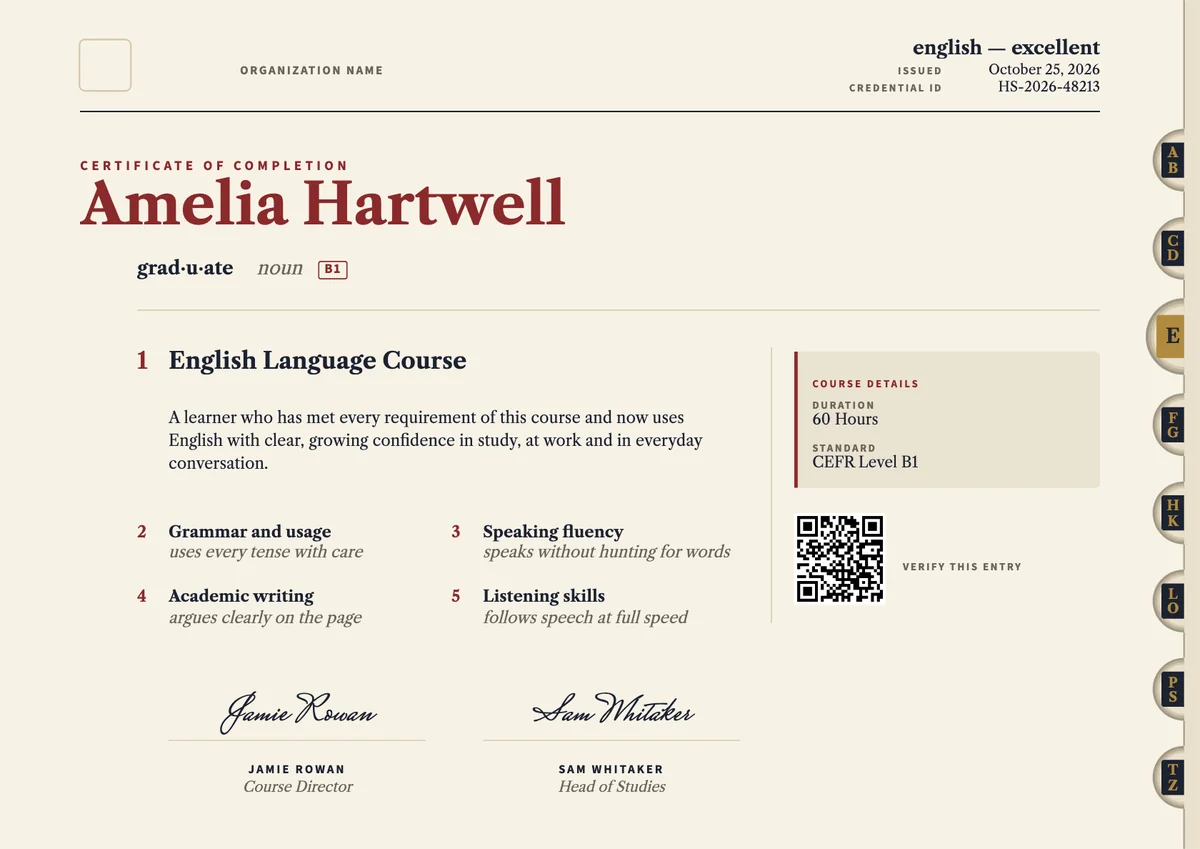
Manuscript Sheet set
Badge · Landscape · Portrait
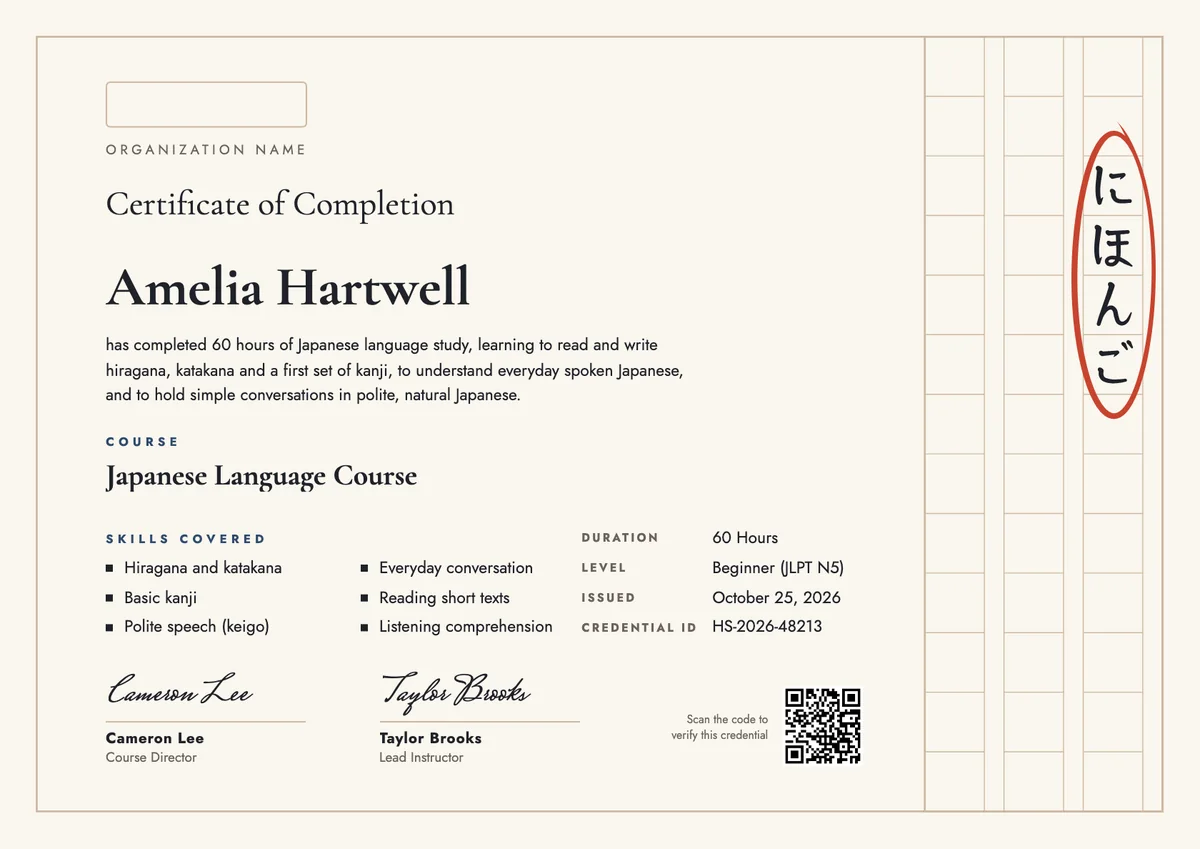
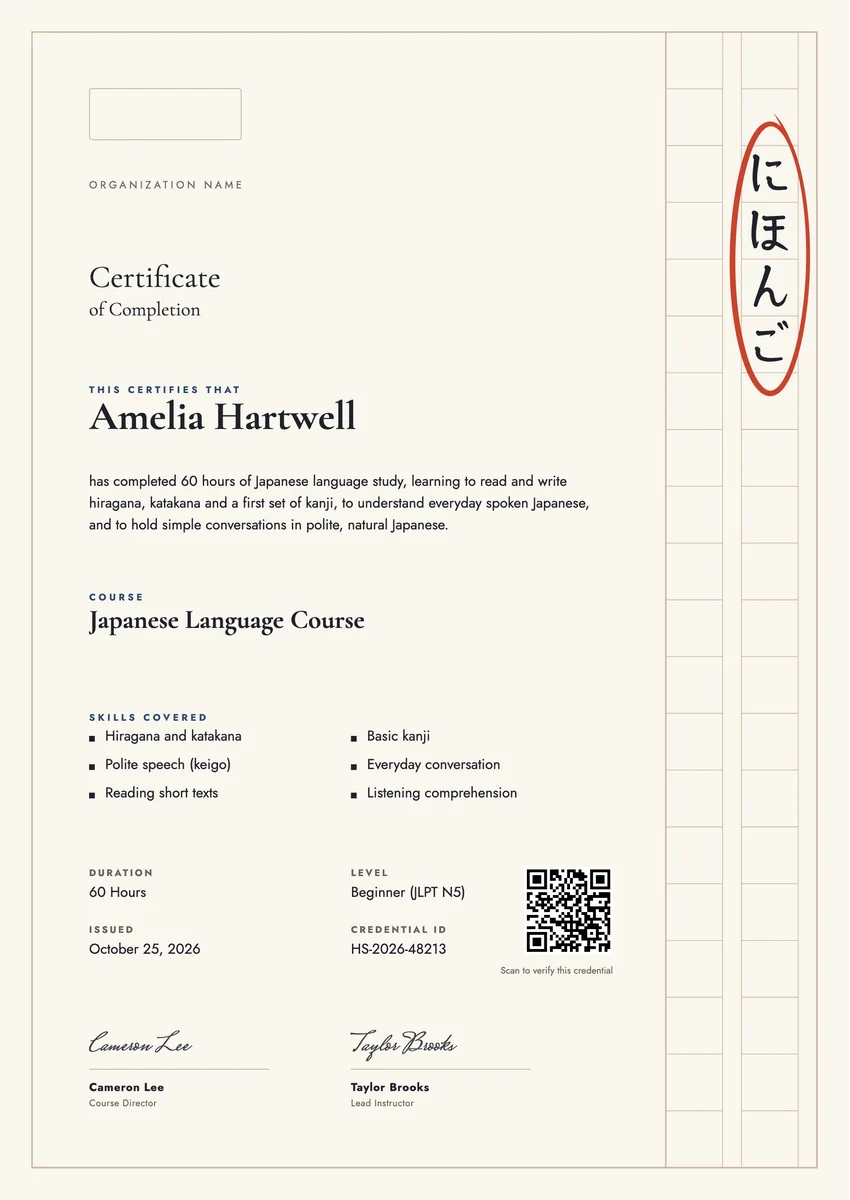
Language schools, universities, cultural centres, private tutors and companies that train staff to work with Japanese partners give a certificate when a learner completes a Japanese course: a beginner evening class, a term of study, an intensive summer programme or a set of business Japanese lessons. A Japanese course certificate template lets the school hand one to every learner on the last day or after the final test.
A useful certificate for Japanese language study records more than attendance. It names the course and its level, gives the hours of tuition, lists what the learner can now do, such as reading hiragana and katakana, writing basic kanji or speaking in polite forms, and may name the JLPT level the course prepares for. It also carries the issue date, a credential ID and a teacher's or director's signature.
The designs come as certificates in A4 and US Letter and as digital badges that learners can share online and anyone can verify.
Wording
What to write on a japanese certificate
Use these lines as they are, or as a start for your own. Every template comes with wording you can change in the studio.
Wording for a Japanese course completion certificate
- “For successfully completing 60 hours of Japanese language study at beginner level.”
- “Has completed Elementary Japanese 1 and can read and write hiragana and katakana and introduce themselves in polite Japanese.”
- “In recognition of the completion of our Business Japanese course, including keigo for meetings, email and the telephone.”
Statements for a Japanese language certificate by level
- “Can read words and short sentences in hiragana, katakana and basic kanji, and follow slow everyday speech (course towards JLPT N5).”
- “Can read short passages on familiar daily topics and follow conversations spoken a little slowly (course towards JLPT N4).”
- “Can read clear articles on everyday subjects and follow natural conversation in everyday situations (course towards JLPT N3).”
Short lines for the badge or the email
- “おめでとうございます! Japanese course complete.”
- “60 hours of Japanese: kana, first kanji and real conversation.”
Why send it with Hyperstack
More than a PDF
Customize the template free. When it is ready, send it to everyone at once.
One design, every name
Upload a spreadsheet and Hyperstack makes a certificate of completion for each person on it, in one go.
Sent by email
Each recipient gets their own email and link. You see who opened it, downloaded it and shared it.
Anyone can verify it
The QR code opens a page that proves the certificate is real. Recipients add it to LinkedIn in one click.
FAQ
Questions, answered
Yes, as long as the wording is honest. The Japanese-Language Proficiency Test (JLPT) is a standard exam run by the Japan Foundation and Japan Educational Exchanges and Services, with five levels from N5, the easiest, to N1, and only the test body can certify a pass. A school can write that its course prepares for a level, for example "Beginner (towards JLPT N5)", but should not suggest the learner holds that level.
Use the level of the course and, if there was a final test, the level the learner was assessed at. Many schools write the JLPT level the course leads towards, for example "Beginner (towards JLPT N5)". Schools that follow the JF Standard for Japanese-Language Education, which uses the CEFR scale from A1 to C2, can show that level instead.
A few words in Japanese, such as the course name or にほんご, make the certificate feel right for the subject, but keep the main record in a language the learner's future employers and schools can read. If you add Japanese text, check it with a native speaker or your teacher before you issue it.
On its own it is rarely enough. Immigration rules and employers in Japan normally ask for a standard test result, such as the JLPT or, for some work visas, the JFT-Basic. A course certificate still shows the hours studied and the skills covered, which supports applications to universities, language schools and the next level of a course.
For beginners, yes. Learning to read and write the two kana scripts and then a first set of kanji are distinct steps, and naming each one shows exactly how far the learner has come. At higher levels, list skills by use instead, such as reading newspaper articles, writing business email or following a lecture.
Your next cohort deserves better than a PDF
Set up in minutes, send your first credentials today, and only pay once you grow past 20 recipients a year.
Or open a live sample credential