TLDR;
- Free credential tools are good for small, low risk issuing needs and early stage programs.
- They handle design and quick distribution well but rely heavily on manual workflows and shallow verification.
- Credential management platforms on the other hand are built for lifecycle control, audit readiness, system verification, and scale.
- Institutions usually outgrow free tooling when verification, revocation, reporting, and integrations become daily needs.
- If your credentials must hold up under scrutiny, infrastructure matters more than template speed.
This guide compares free credential generators and badge tools with modern credential management platforms used by institutions in 2026.
Why this Differentiation Matters
If you simply search for a “certificate generator” today, you will get hundreds of tools that promise results in minutes. And to be fair, many of them deliver exactly that. You upload a template, type a few names, click generate, done.
Most of these tools fall into the category of certificate generators or badge creators. They are designed for fast issuing, not long term credential management. That difference is small at the start and significant over time.
For small programs, workshops and internal recognitions; sticking to a simple workflow makes more sense.
The confusion starts when institutions assume the same tools/systems can support long term credential programs, partner verification, audits, and cross platform checks. On the surface, everything still looks okay. Underneath, the cracks show up slowly, as new innovations and standards are expected to be upheld.
If you are unsure where you fall, schedule a working session with the Hyperstack team and map your use case before you commit tooling.
Most credential software looks similar in screenshots. A badge here, a certificate there, a download button somewhere in the corner. The difference only becomes obvious when someone asks you to prove something about what you issued six months ago.
That is usually when the real evaluation begins.
This guide walks you through how free credential tools compare with credential management platforms, using real-world capability differences instead of marketing labels.
In practice, they are talking about lightweight generators and badge makers that prioritize speed and accessibility.
You open the tool, select a template, fill in the names, export the output, and proceed. These tools are optimized for fast creation and low-friction entry. They are especially common in short programs, internal recognition efforts, and pilot cohorts where operational risk is low and verification demands are minimal.
The friction does not appear at creation time. It appears later, when records need to be checked, corrected, revoked, or verified by someone outside of your organization.
Here's something worth remembering: Creation is just a moment. Verification is the actual lifespan.
A few free or free tier credential tools appear frequently in education, creator, and training workflows. Not as infrastructure platforms, but as fast issuing utilities.
Canva certificate templates are widely used because the design is simple and familiar. Teams can produce attractive certificates quickly, but verification, lifecycle control, and system-level validation are outside their scope. It handles presentation well, but credential governance is usually outside its scope.
 Source: Canva Certificate Templates
Open Badge Designer, and similar tools are used for badge graphics and metadata packaging. They are useful for designing badge visuals and basic structures, but they do not function as full issuing and lifecycle platforms on their own.

Simple generators are optimized for speed and batch name merging. They typically rely on downloadable files and manual record keeping rather than system level credential registries. This may reduce formatting effort but they still depend on manual tracking and external verification handling.
All three are useful in the right context. Neither is built to function as an institutional credential infrastructure.
On paper, yes. On the operations side, not always.
When credential volume is small, manual handling feels manageable. As volume rises, hidden workload becomes apparent through correction requests, resend requests, verification emails, duplicate record checks, and version confusion. None of these issues are software errors. They are workflow burdens.
Teams often discover that the software cost stayed at zero while the coordination cost grew quietly in the background. Finance never sees that line item. Operations feels it every week.
Time is the line item that free tools invoice later.
Free credential tools tend to feel perfectly reliable right up to the moment volume and scrutiny increase together.
The first strain usually appears in corrections, where bulk updates turn into manual rework across individual records instead of controlled batch edits. Revocations become awkward, often handled through patchwork notes or replacement files rather than enforceable status changes.
Verification requests start piling into inboxes, each one needing a human lookup and confirmation instead of a system check.
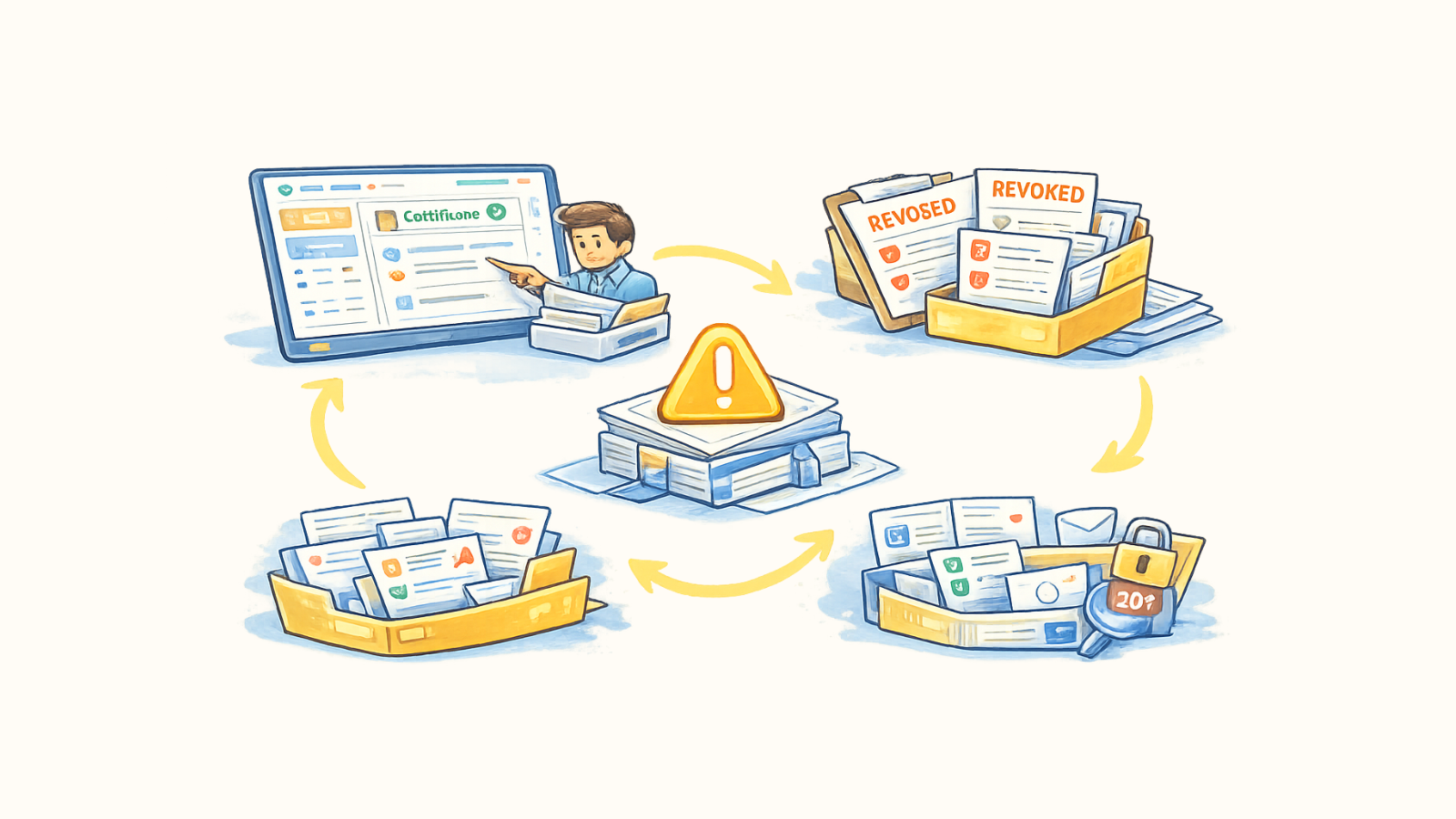 Reporting follows the same pattern, with teams stitching together spreadsheets and export files to answer simple oversight questions.
Nothing ever fails dramatically, but the operational load rises quietly until a breaking point. That is typically the point where convenience tooling runs out and control tooling earns its place.
It depends less on the calendar year and more on the program pressure.
If credentials are low stakes, rarely verified, and easy to replace, lighter tools remain viable. If credentials are used for eligibility, hiring signals, compliance evidence, or partner recognition, expectations change. Verification requests become routine. Revocation becomes necessary. Historical records must stay accessible and provable.
Institutions that succeed with free tooling usually have low verification pressure and low governance pressure. Once either increases, process strain follows.
The break point is rarely dramatic. It is usually administrative.
If you are mapping future credential volume or partner verification needs, you could book a short platform walkthrough with our team of experts, to help you model the right setup before you commit to either a free credential tool or any credential management platform of your choice.
Simply put, the design screen starts to matter less and the control layer starts to matter more.
Credential management platforms are already structured around lifecycle handling. That means issuing, updating, verifying, revoking, logging, and reporting are treated as first-class functions.
Verification is typically registry-backed or cryptographically anchored rather than visual only. Audit trails are recorded automatically. Role-based access replaces shared inbox workflows. System integrations allow other platforms to validate credentials without sending emails back to the issuer.
This lifecycle layer usually includes issuance records, update history, revocation status, verification endpoints, and structured credential metadata that can be checked by external systems.
The mental model shifts from document creation to credential governance.
A different center of gravity.
A modern platform in this category usually supports bulk issuing through controlled workflows, allows post-issue updates under policy rules, records revocation events cleanly, maintains audit logs by default, and exposes verification endpoints for partner systems. It also tends to support standards alignment, identity binding, and reporting layers that help institutions answer oversight questions without manual reconstruction.
Free tools focus on output. Management platforms focus on traceability.
Both are valid, but only one is built for scrutiny.
What usually happens when verification requests become frequent
Verification volume is a useful stress test.
With lightweight tools, verification often routes through people. Someone checks a record, confirms a file, and replies manually. With management platforms, verification is designed to be system-resolvable. A third party can check the status without waiting for human confirmation.
Credential management platforms, on the other hand, are designed to support direct verification checks without issuer intervention.
When verification becomes frequent, manual confirmation models slow everything down. System verification models absorb the load more easily.
A simple and effective process design always beats inbox heroics.
Several credential management platforms are used by universities, training providers, and enterprise L&D teams when lifecycle control, security and system verification are key deal breakers . Examples include platforms such as Credly, Accredible, and Hyperstack.
These platforms are built around structured issuing workflows, verification infrastructure, revocation controls, audit logs, and ecosystem integrations. The differences between them usually come down to standards support, integration depth, easy adoption of dashboard controls, and deployment flexibility rather than visual certificate design quality.
Most institutions evaluate two or three platforms side by side based on verification model, compliance readiness, and integration fit before selecting one.
If your team is debating whether your current tooling is enough, that is already a signal worth exploring. Mapping credential volume, verification expectations, partner requirements, and compliance exposure usually clarifies the answer quickly.
You can schedule a working demo with Hyperstack and walk through your exact credential workflow with our credentialing specialists. No pressure, just a technical fit discussion at your convenience.
A simple internal filter most teams would find useful:
Before you take a decision, ask whether your credentials need to be: 1. Provable, 2. Revocable, 3. System verifiable, and 4. Audit traceable over time.
If most answers are yes, your tooling choice should no longer be about convenience.
It must now reflect intuitive infrastructure because your credentials may look like files today but they'll always behave like records forever.
And your decisions should reflect that reality early, and not after friction appears.
FAQ's
What are free credential tools best used for?
Free credential tools are best used for small programs, pilot cohorts, and low-risk issuing scenarios where quick certificate or badge creation matters more than advanced verification, audit trails, and lifecycle controls.
Are free credential tools enough for institutional credential programs?
Free credential tools can work for limited scale programs, but most institutions outgrow them when credential verification, revocation, reporting, and system integrations become regular operational needs.
What is the difference between a credential generator and a credential management platform?
A credential generator focuses on quickly creating certificates or badges, while a credential management platform supports the full credential lifecycle, including verification, revocation, audit logs, governance controls, and integrations.
Can credentials issued with free tools be verified automatically?
In most cases, credentials issued with free tools require manual or visual verification. Credential management platforms are designed to support automated or registry-based verification without manual issuer involvement.
When should an organization move to a credential management platform?
An organization should move to a credential management platform when credentials must be provable, revocable, system verifiable, audit traceable, and maintained reliably over time.