Choosing digital badge and certificate software used to be relatively straightforward in the good old days.
Most organizations focused on familiar requirements. Templates needed to look professional. Email delivery needed to work reliably. Administrators wanted a simple way to issue credentials without creating additional work.
Those expectations have not disappeared in 2026. What has evolved is the entire process that follows the issuance of a credential.
Training providers are now managing larger learner populations while professional associations are maintaining certifications that remain active for years. Employers are bound to expect achievements to be verified immediately. Recipients are increasingly required to maintain access to their credentials long after a course or certification cycle has ended.
As these expectations have evolved, software evaluations have changed alongside them.
TL;DR
If you're evaluating digital badge and certificate software, prioritize platforms that support:
- Verifiable credentials and Open Badges
- Secure certificate and badge verification
- Bulk credential issuance and workflow automation
- Recipient claim portals and digital wallets
- LMS integrations, including Canvas and Blackboard
- APIs and enterprise integrations
- Analytics and reporting
- LinkedIn and social sharing
- Credential portability and long-term accessibility
- GDPR readiness and administrative controls
The most effective platforms help organizations issue, manage, verify, and scale credentials while improving learner experiences and reducing operational complexity.
Questions around workflow automation, verification, standards support, integrations, and long-term accessibility appear much earlier in procurement discussions than they once did. What begins as a search for certificate software often becomes a broader conversation about how credentials will be managed, verified, and maintained throughout their lifecycle.
For organizations issuing credentials at scale, platform decisions influence more than administration. They shape learner experiences, employer trust, and operational efficiency. Hyperstack is built to shine in this environment, its infrastructure being robust, secure, and intuitive in its application.
What Features Should Organizations Look for in Digital Badge and Certificate Software?
After facilitating the issuance of millions of credentials, we noticed organizations considering a change usually begin their evaluation with a list of features.
The process usually starts with operational challenges.
Support teams spent hours responding to credential requests. Administrators sit with repetitive issuance workflows. Employers ask questions about verification. Program managers begin thinking about scale.
These pressures eventually translated into platform requirements.
Across training providers and certification bodies, several capabilities appear consistently during evaluations:
- Verifiable credentials
- Open Badges support
- Workflow automation
- Recipient claim portals
- Secure verification
- LMS integrations
- Analytics and reporting
- LinkedIn sharing
- Credential portability
- Long-term accessibility
Each of the above requirements addresses a problem organizations encounter as programs grow.
Verification requirements have changed alongside hiring and certification practices.
Employers reviewing applicants routinely encounter credentials issued by organizations they have never worked with before. Professional associations often issue certifications that influence promotions, continuing education requirements, and career progression. Manual verification becomes increasingly difficult as these ecosystems expand.
This explains why verifiable credentials and Open Badges are receiving greater attention.
Platforms supporting:
- Open Badges standards
- Verifiable credentials
- Badge verification
- Certificate verification
- Digital wallets
- Metadata-rich credentials
Allow organizations to create credentials that remain useful beyond the point of issuance.
Standards support also improves portability. Training providers and certification bodies evaluating digital credential software are increasingly considering how credentials will function across different systems and over longer periods of time.
Try Digital Certificate Security and Compliance from our blog series to understand how verification and trust influence long-term credential value at scale.
Why Is Bulk Credential Issuance Important?
Growth introduces complexity; you've seen it. It's inevitable.
Processes that work well for a few hundred credentials can become difficult to manage when programs expand into the thousands.
Manual issuance creates bottlenecks, for obvious reasons. Minor errors become much harder to detect. And administrative teams spend increasing amounts of time performing repetitive tasks, just magnified even more by sheer volume.
As credential volumes increase, consistency becomes just as important as speed.
This is why organizations issuing large numbers of badges and certificates often prioritize the following:
- Batch issuance
- Scheduled delivery
- Dynamic templates
- Approval workflows
- Renewal workflows
- Automated email distribution
These capabilities help maintain quality while reducing operational overhead.
For organizations running certification programs, continuing education initiatives, or workforce development programs, bulk issuance and automated delivery often become essential components of scalability.
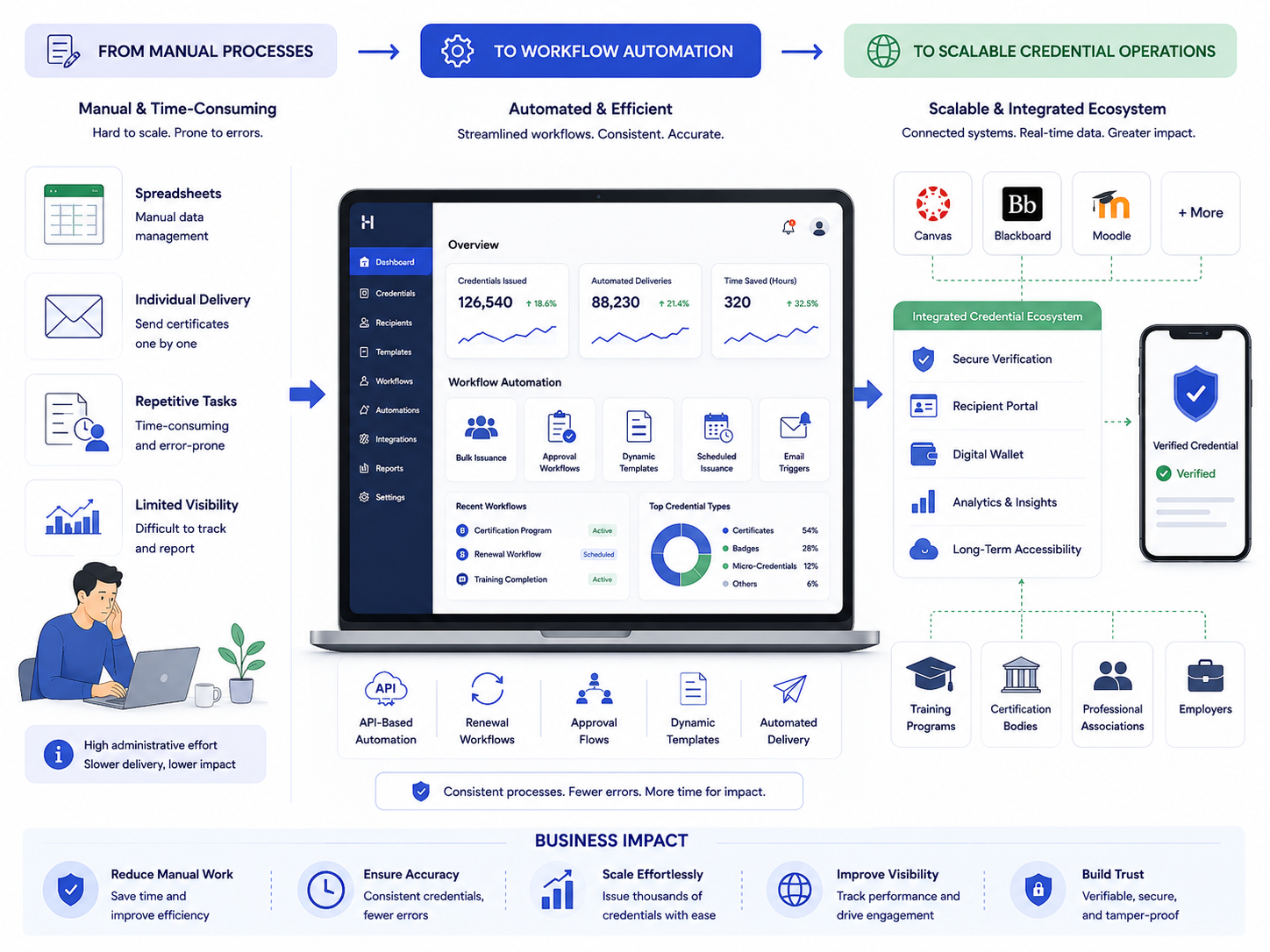
What Workflow Automation Features Matter Most?
Administrative complexity rarely increases all at once.
Small inefficiencies gradually accumulate into a gargantuan mess.
Support teams spend more time than necessary answering simple questions. Program managers may be forced to oversee multiple workflows as renewal processes become harder to track.
Manual tasks almost always begin competing with strategic priorities.
Automation helps organizations absorb this complexity without increasing administrative burdens.
Common capabilities of digital badge and certification platforms include the following:
- Automated delivery
- Approval workflows
- Scheduled issuance
- Dynamic templates
- Renewal and recertification workflows
- API-based automation
- Email triggers
These features help maintain consistency across programs while giving administrators more time to focus on learner outcomes and program development.
Organizations evaluating digital credential software frequently view workflow automation as a long-term operational investment rather than a short-term convenience.
Which LMS Integrations Should Digital Badge and Certificate Software Support?
Credential programs rarely operate in isolation.
Learner records, assessments, and course data often reside within existing systems. Without reliable synchronization, teams end up managing duplicate records and introducing unnecessary errors.
This explains why integrations receive increasing attention during software evaluations.
Training providers and certification bodies commonly look for support for:
Canvas
Widely adopted across higher education and professional learning environments.
Blackboard
Frequently used for continuing education and certification programs.
Moodle
Popular among workforce development and skills training initiatives.
TalentLMS and Docebo
Often used for enterprise learning and professional development.
APIs
Support custom workflows and enterprise connectivity.
Reliable movement of information between systems helps reduce administrative effort while improving accuracy.
Learn more about LMS integrations to understand how Hyperstack supports long-term verification and interoperability.
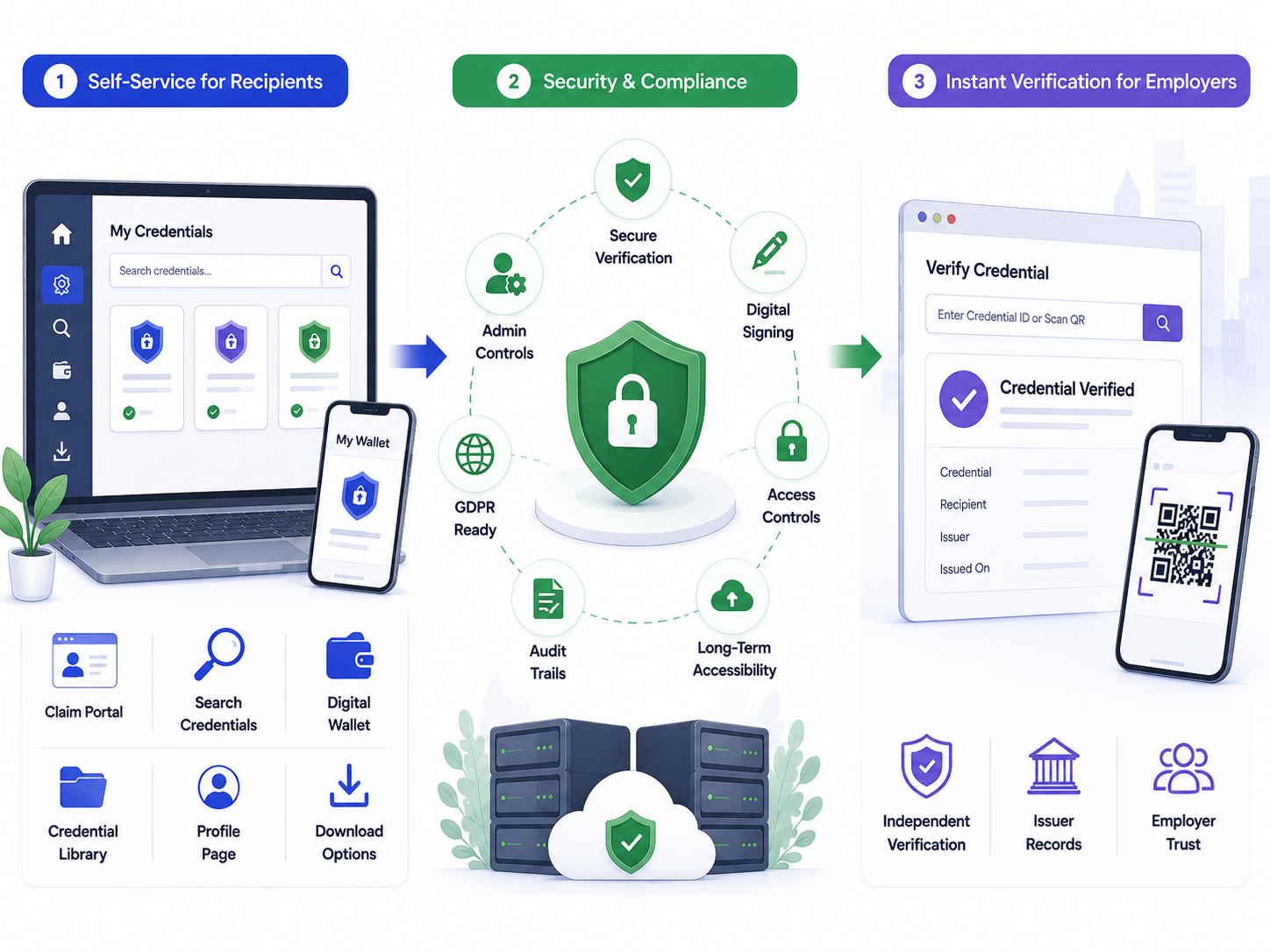
Recipient expectations have evolved alongside consumer technology.
Learners expect immediate access. They expect credentials to be searchable. We'd all love to retrieve our achievements without submitting support requests.
But, as credential volumes grow, we noticed that these expectations affect administrators as much as recipients.
Organizations frequently evaluate:
- Credential claim portals
- Search functionality
- Digital wallets
- Credential libraries
- Recipient profile pages
- Download options
Self-service capabilities usually reduce support workloads while helping recipients maintain access to achievements throughout their careers.
And after assisting organizations in issuing millions of credentials, we noticed that the most effective credential experiences often require the least amount of administrative intervention.
What Security and Compliance Features Should Certificate Software Include?
Security and compliance discussions usually intensify as programs mature.
Verification requests increase. Retention requirements become more important. Regulatory expectations evolve. Organizations begin thinking beyond issuance and considering record integrity over longer periods.
These considerations have elevated the importance of:
- Secure verification
- Cryptographic signing
- Audit trails
- Administrative permissions
- Access controls
- GDPR readiness
- Credential portability
- Long-term accessibility
- Record integrity
Professional associations and certification bodies often place additional emphasis on these areas because credentials may remain active and relevant for years.
Security requirements are also becoming more visible during procurement reviews and accreditation assessments.
How Do Employers Verify Digital Badges and Certificates?
Verification requirements have changed alongside hiring practices.
Employers reviewing applicants encounter credentials from universities, bootcamps, professional associations, and training providers around the world. Contacting issuers manually becomes impractical when hiring decisions need to be made quickly.
Independent verification helps reduce this friction.
Modern verification systems support:
- Badge verification
- Certificate authentication
- Digital certificate verification
- Issuer-controlled records
- Independent validation
These capabilities help recipients demonstrate achievements more efficiently while giving employers greater confidence in the results.
Organizations investing in verification infrastructure improve experiences for both audiences.
How Important Are LinkedIn and Social Sharing Features?
Credentials derive value from visibility.
Recipients more frequently anticipate accomplishments to move with them across professional networks and digital profiles.
Simple sharing capabilities support:
- LinkedIn profiles
- Professional websites
- Digital portfolios
- Email signatures
These interactions extend the reach of credential programs while increasing visibility for issuers.
Analytics around sharing activity also provide useful insights into recipient engagement and credential usage.
Can Digital Badge and Certificate Software Scale to Thousands of Credentials?
Scale affects almost every aspect of credential management.
Programs issuing thousands of credentials annually face different operational requirements from those managing a few hundred recipients.
As programs grow, organizations frequently evaluate the following:
- Template management
- Bulk issuance
- Email delivery reliability
- Reporting capabilities
- Search portals
- API connectivity
- Verification infrastructure
Scalability influences efficiency, consistency, and learner experiences.
Software decisions that appear minor during the early stages of a program often become far more significant as credential volumes increase.
What Analytics Features Help Measure Credential Engagement?
Issuing credentials marks the beginning of a learner's journey rather than the end.
Organizations increasingly want to understand how credentials are being used after issuance.
Common metrics include:
- Credential views
- Shares
- Claim rates
- Verification activity
- Engagement trends
These insights help demonstrate learner outcomes and support reporting requirements.
Analytics also help organizations understand which programs create the greatest impact and engagement.
What Happens If Your Credential Provider Shuts Down?
Long-term accessibility has become an increasingly common topic during procurement reviews.
Organizations issuing certifications with multi-year validity periods need confidence that records will remain available in the future.
Questions frequently raised include:
- Will learners retain access?
- Can records be exported?
- Are credentials portable?
- Will verification remain available years later?
- Can data migrate to another platform?
These concerns reflect a broader emphasis on resilience and long-term trust.
Explore Credential Risk Management for Training Providers to understand how organizations address operational risks across the credential lifecycle.
Feature comparisons tell only part of the story.
Most organizations evaluate software through the lens of their own operational realities.
Program managers focus on efficiency. IT teams examine integrations. Compliance teams review security and governance. Administrators consider learner experiences. Leadership teams think about scale and long-term sustainability.
These different perspectives often converge around a common set of priorities:
- Verification capabilities
- Workflow automation
- Standards support
- Integrations
- Security and compliance
- Analytics and reporting
- Scalability
- Long-term accessibility
The strongest platforms help organizations address these requirements simultaneously.
A Practical Evaluation Checklist
Before selecting digital badge and certificate software, consider whether the platform supports the following:
✓ Verifiable credentials
✓ Open Badges standards
✓ Secure digital certificates
✓ Bulk credential issuance
✓ Workflow automation
✓ Recipient claim portals
✓ LinkedIn sharing
✓ Canvas and Blackboard integrations
✓ APIs
✓ Audit trails
✓ Analytics and reporting
✓ Credential portability
✓ Long-term accessibility
✓ Secure verification
✓ GDPR readiness
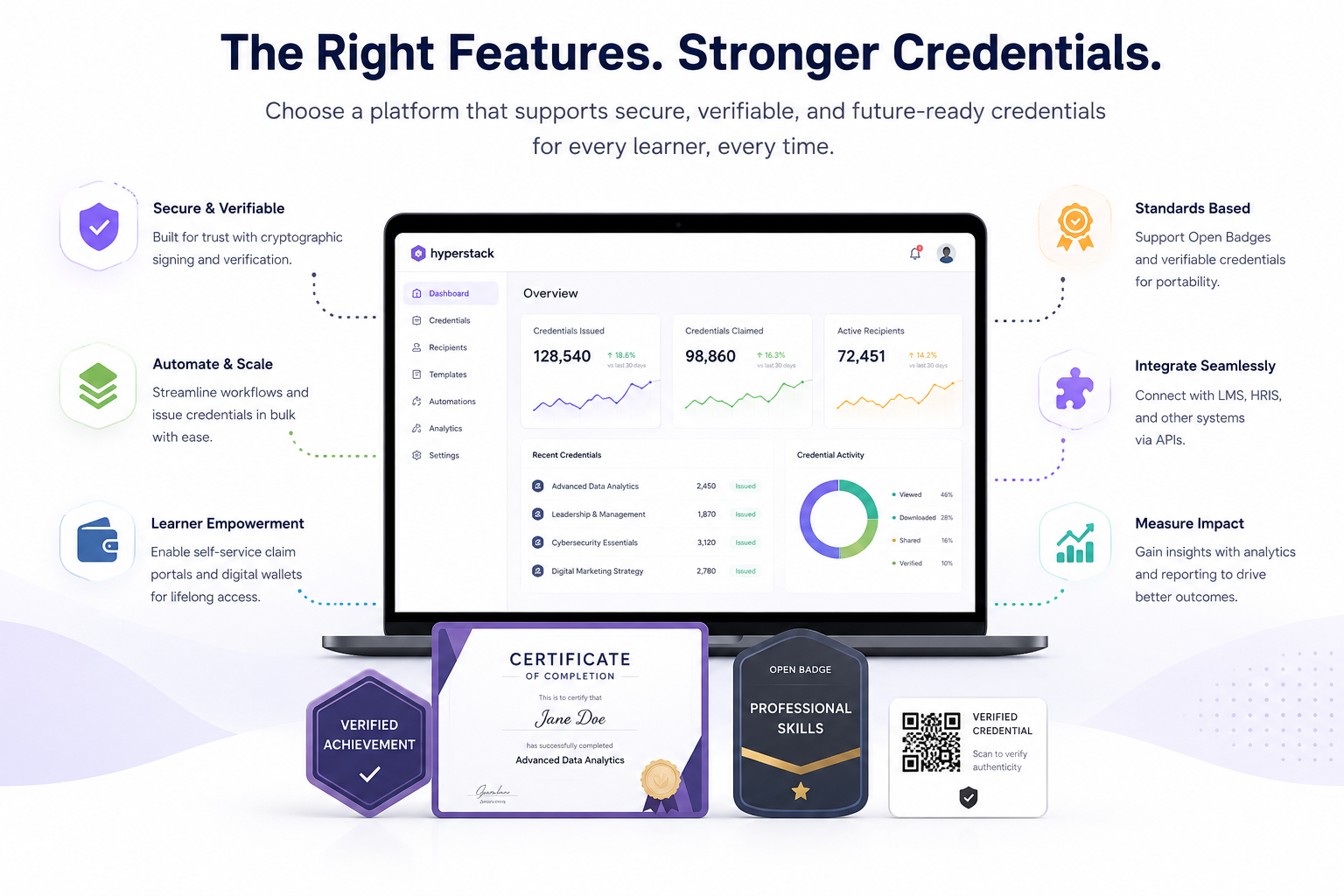 Evaluate Your Current Credential Infrastructure
Many organizations discover workflow limitations, verification gaps, or administrative bottlenecks only after programs begin to scale.
A structured review often highlights opportunities to strengthen verification, improve learner experiences, and simplify operations.
Schedule a demo to explore how modern digital badge and certificate platforms support verifiable credentials, workflow automation, secure verification, and long-term credential trust.
Continue Exploring
- Digital Certificate Security and Compliance for Training Providers
- Certificate Fraud Intelligence: How Fake Certificates Are Evolving
- Digital Certificate Infrastructure Explained
- Verification Ecosystems: Why Trust Extends Beyond the Issuer
- Credential Risk Management for Training Providers
- Open Badges vs. Certificates: Which Format Should Training Providers Use?
- How Employers Verify Digital Certificates and Digital Badges
Ready to Evaluate Your Current Badge and Certificate Software?
Training programs and certification bodies are placing greater emphasis on automation, verification, interoperability, and long-term credential trust.
Reviewing existing processes often reveals opportunities to simplify operations and improve experiences for learners, employers, and administrators.
Schedule a demo to see how organizations issuing digital badges, certificates, and verifiable credentials are building more scalable and trusted credential ecosystems with Hyperstack.
FAQs
1. What features should I look for in digital badge and certificate software?
Look for platforms that support verifiable credentials, Open Badges standards, workflow automation, bulk credential issuance, recipient claim portals, analytics, LMS integrations, secure verification, and long-term accessibility.
2. Which badge and certificate software supports verifiable credentials?
Modern credential platforms increasingly support verifiable credentials and Open Badges standards, allowing organizations to issue credentials that can be independently verified and remain portable across different systems.
3. How do employers verify digital badges and certificates?
Employers typically verify digital credentials through secure verification pages, QR codes, unique credential identifiers, and issuer-controlled records that confirm authenticity without contacting the issuing organization directly.
4. Why is bulk credential issuance important for training providers?
Bulk credential issuance reduces manual work, minimizes errors, and enables training providers to deliver thousands of credentials efficiently while maintaining consistency across programs.
5. What is a credential claim portal?
A credential claim portal allows recipients to access, search, download, and manage their credentials independently without relying on administrative support teams.
6. What security features should digital certificate software include?
Digital certificate software should include secure verification, audit trails, access controls, administrative permissions, cryptographic signing, GDPR readiness, and long-term record accessibility.
7. What is the difference between digital badges and certificates?
Digital certificates generally recognize completion or achievement, while digital badges often include richer metadata about skills, competencies, and evidence. Many organizations use both formats together within a digital credential ecosystem.
8. Why do training providers need Open Badges support?
Open Badges support improves interoperability, credential portability, and long-term accessibility, allowing recipients to use their achievements across different platforms and professional networks.
9. Which LMS integrations are important for digital credential software?
Training providers commonly look for integrations with Canvas, Blackboard, Moodle, TalentLMS, Docebo, and APIs that support custom workflows and enterprise systems.
10. Can digital badge and certificate software scale to thousands of credentials?
Modern digital credential platforms are designed to support high-volume issuance through workflow automation, bulk delivery, dynamic templates, and automated verification infrastructure.
11. How do self-service credential portals reduce administrative work?
Self-service portals allow recipients to claim, search, and download credentials independently, significantly reducing support requests and manual administrative tasks.
12. What is credential portability?
Credential portability refers to a recipient's ability to access and share their credentials across different platforms and systems without losing verification or ownership.
13. How do professional associations use digital badges and certificates?
Professional associations use digital credentials to manage certifications, continuing education programs, member recognition initiatives, and long-term verification of professional achievements.
14. What analytics should digital badge and certificate software provide?
Organizations often look for analytics covering credential views, shares, claim rates, verification activity, recipient engagement, and program performance.
Organizations should evaluate whether credentials remain portable, exportable, and accessible over the long term, including how verification and recipient access are maintained if a platform changes.